
The Life and Death of Stars: From Supernovae to Neutron Stars and Black Holes
Stars are born in molecular clouds and evolve according to their mass. Their final stages can produce white dwarfs, supernovae, neutron stars, or black holes, while dispersing elements that help form future stars, planets, and life.
Share this story
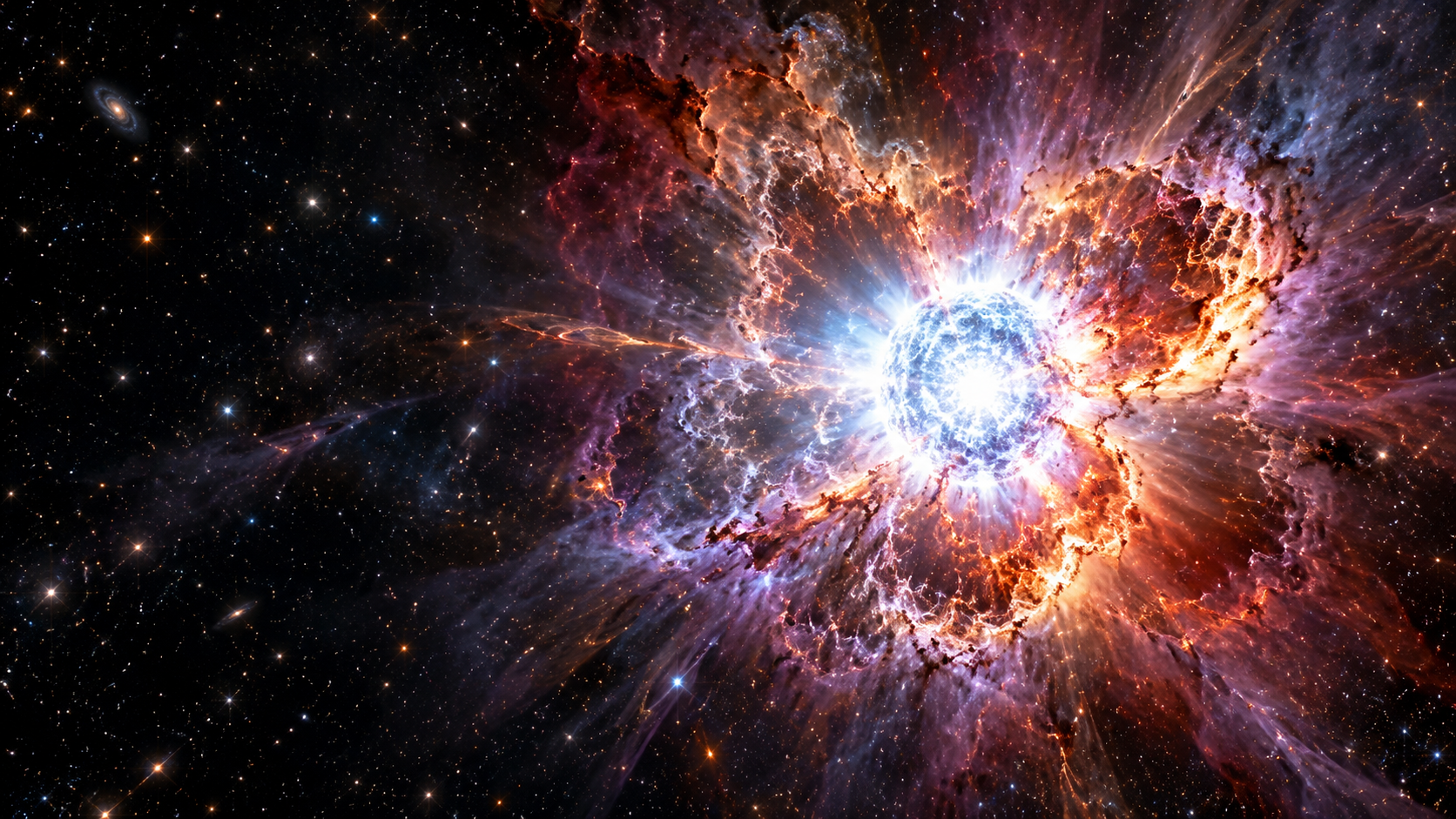
The night sky often appears calm and unchanging, yet every star is at a different stage of its life. Some are only beginning to form within clouds of gas and dust, others have been shining steadily for millions or billions of years, and some are approaching one of the most powerful events in the Universe: a supernova explosion.
The life of a star is a story of both creation and transformation. Many chemical elements are produced inside stellar cores, and at the end of a star’s life, this material is dispersed into space, becoming the raw material for future stars, planets, and other cosmic objects.
A star’s evolutionary path is determined primarily by its initial mass. Mass governs the temperature of the core, the rate at which nuclear fuel is consumed, and the type of remnant that may remain after the star dies.
Stars are not eternal objects. Their birth, evolution, and death continuously recycle matter throughout the Universe.
The Birth of a Star: Molecular Clouds
Stars form inside cold, dense accumulations of gas and dust known as molecular clouds. Hydrogen is the primary component of these clouds, but they also contain helium and dust grains made of heavier elements.
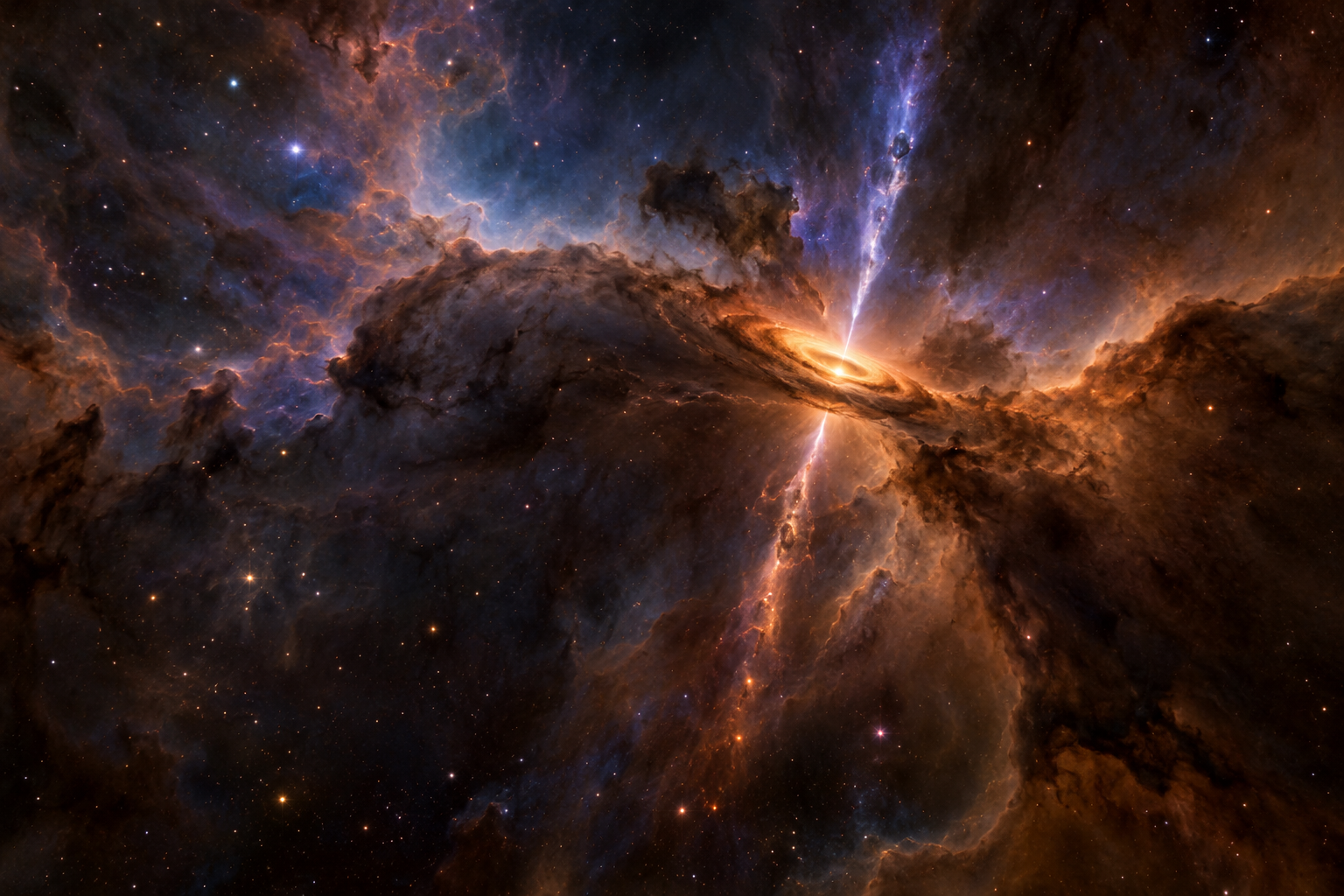
When the density of material in a region of a cloud becomes sufficiently high, gravity begins to overcome gas pressure. The material contracts, the central region heats up, and a protostar forms. At this stage, the primary source of energy is gravitational contraction rather than nuclear fusion.
As contraction continues, the temperature and pressure in the protostar’s core rise until hydrogen nuclei can begin fusing into helium. At that point, the star enters the longest and most stable phase of its life: the main sequence. The duration of stellar formation and evolution depends strongly on mass. Low-mass stars can survive for trillions of years, while very massive stars may live for only a few million years. [1]
The Main Sequence and Hydrostatic Equilibrium
During the main-sequence phase, a star maintains hydrostatic equilibrium. Gravity pulls stellar material inward, while the thermal and radiation pressure produced by nuclear reactions pushes outward.
In stars like the Sun, hydrogen fusion occurs mainly through the proton-proton chain. In more massive and hotter stars, the carbon-nitrogen-oxygen, or CNO, cycle plays a significant role. In both cases, the result is the production of helium and the release of a large amount of energy.
Massive stars are much brighter, but they consume their fuel far more quickly. Therefore, greater stellar mass does not mean a longer life. On the contrary, it usually means a shorter but more energetic existence.
When Nuclear Fuel Changes a Star’s Fate
A star does not use up all of its hydrogen at once. Instead, the chemical composition of its core changes first. As hydrogen in the central region becomes depleted, the core begins to contract and heat up, while the outer layers expand.
In Sun-like and low- to intermediate-mass stars, this leads to the red giant phase. Eventually, the star expels part of its outer layers, forming a planetary nebula, while a hot and dense white dwarf remains at the center. A white dwarf does not begin new nuclear fusion reactions; it gradually cools over time while remaining stable through electron degeneracy pressure.
The late stages of stars with approximately eight or more times the mass of the Sun are far more complex. These stars successively fuse helium, carbon, neon, oxygen, and silicon. The result is an onion-like layered structure, with iron-group elements accumulating in the center.
Iron represents a turning point. Under ordinary stellar conditions, the fusion of nuclei heavier than iron does not release energy; instead, it requires energy. As a result, the stellar core loses the energy source needed to resist gravitational collapse.
Core Collapse and Supernova Explosions
After the iron core grows sufficiently massive, the center of a massive star can collapse within fractions of a second. Under extreme density, electrons combine with protons to form neutrons and neutrinos. The central core becomes extraordinarily dense, while the collapse is temporarily slowed by nuclear forces and neutron degeneracy pressure.
Simplified explanations often state that matter “hits the core and immediately bounces back.” The actual process is more complex. The initial shock wave can lose energy and stall, while neutrino energy transfer, turbulent flows of matter, and hydrodynamic instabilities may help revive the explosion. The precise mechanism of supernova explosions remains an active area of scientific research. [5]
Such explosions are called core-collapse supernovae and, depending on their spectral characteristics, are classified as Type II, Type Ib, or Type Ic supernovae. They eject material previously synthesized by the star into the interstellar medium, stimulating new star formation and enriching the chemical composition of galaxies. [3]
Type Ia Supernovae: Cosmic Distance Indicators
Another major group of stellar explosions is known as Type Ia supernovae. These events are generally associated with carbon-oxygen white dwarfs in binary systems. When a white dwarf accretes matter from a companion star or merges with another white dwarf, an uncontrolled thermonuclear reaction may begin and destroy the star.
The Chandrasekhar limit, approximately 1.4 solar masses, is an important theoretical threshold for white dwarf stability. However, modern research shows that not all Type Ia supernovae necessarily explode after reaching this exact mass. Sub-Chandrasekhar scenarios and white dwarf merger models are also considered. [8]
Type Ia supernovae are not perfectly identical explosions. However, after correcting for the shape of their brightness curves and their color, their luminosity can be standardized. For this reason, they are used to measure distances to remote galaxies and have played a major role in the study of the accelerating expansion of the Universe.
Neutron Stars and Pulsars
If the mass of the remaining core after collapse is not too large, it may stabilize as a neutron star. A neutron star can contain a mass comparable to, or even greater than, that of the Sun within a sphere only a few tens of kilometers across.
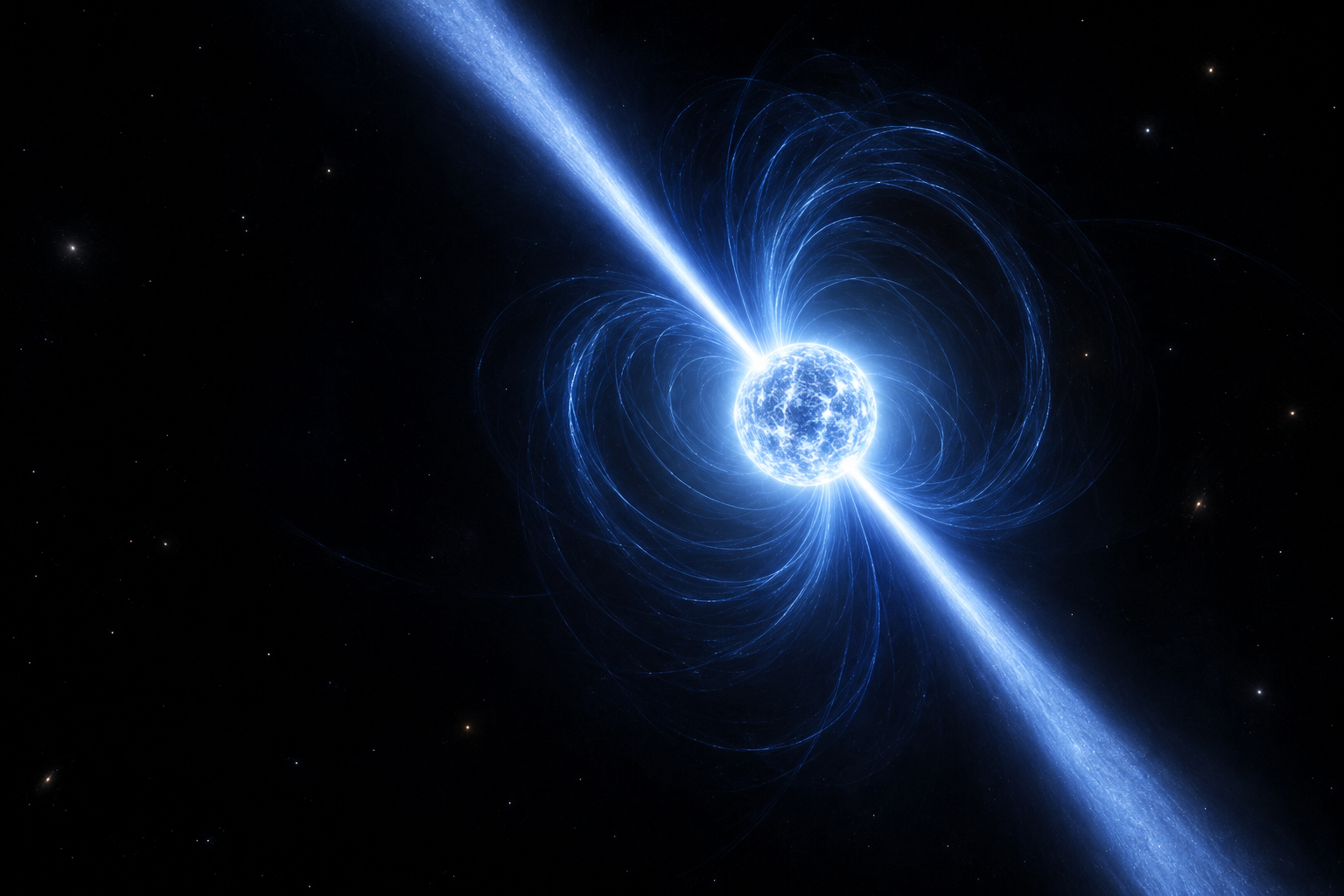
The density of neutron-star matter is so extreme that a small amount of it would weigh billions of tonnes under Earth-like conditions. The exact state of matter inside these objects is still not fully understood, making neutron stars important natural laboratories for nuclear physics. [6]
Some neutron stars rotate extremely rapidly and possess powerful magnetic fields. If beams of radiation produced near their magnetic poles periodically cross Earth’s line of sight, astronomers observe regular pulses. Such objects are called pulsars. They are among the most precise natural “clocks” in astronomy. [7]
Black Holes and the Event Horizon
If the mass of a stellar remnant exceeds the limit that neutron matter can support, collapse continues and a stellar-mass black hole forms. The limiting mass depends on the equation of state of dense matter, so it is not a single fixed number. It is generally discussed as being on the order of approximately two to three solar masses.
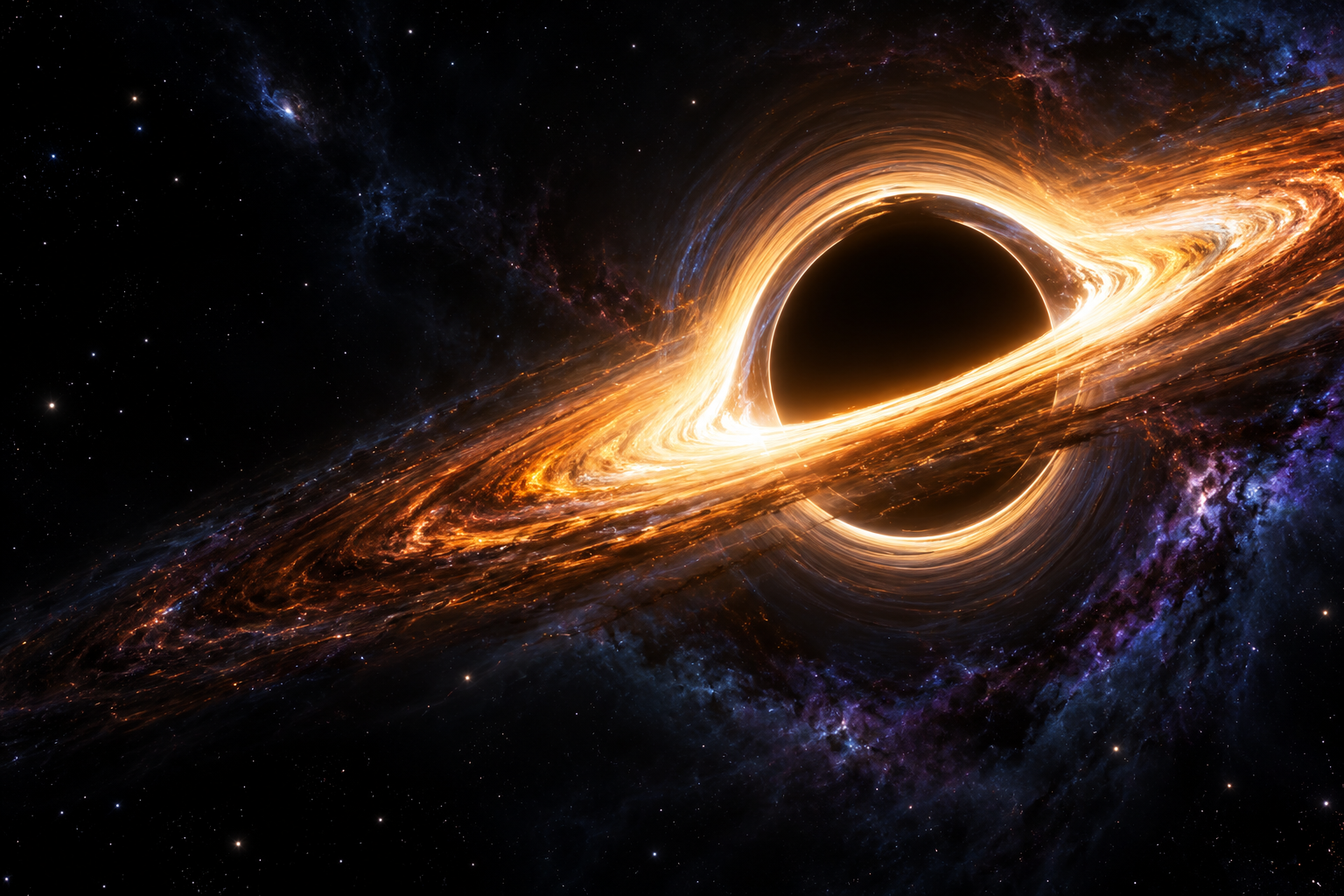
The defining observable boundary of a black hole is the event horizon: the boundary beyond which no signal, including light, can reach an outside observer. A black hole cannot be observed directly, but it can be detected through radiation from surrounding matter, the orbital motion of nearby stars, or gravitational waves.
The equations of classical general relativity predict a singularity, a region of extremely high density. However, a singularity should not be presented as an observationally confirmed “point of infinite density.” It also indicates that, under such extreme conditions, general relativity may need to be supplemented by a more complete theory of quantum gravity.
Conclusion
The death of a star is not the end of a cosmic story, but rather a stage in the recycling of matter. White dwarfs, neutron stars, and black holes are remnants of earlier stellar generations, while the material expelled by supernovae becomes the raw material for new stars and planets.
In this sense, many of the elements found on Earth have a stellar past. The study of stellar evolution explains not only some of the most powerful events in the distant Universe, but also our own material origins.
Sources
[1] NASA Science — Stars
https://science.nasa.gov/universe/stars/
[2] NASA/James Webb — Star Lifecycle
https://science.nasa.gov/mission/webb/star-lifecycle/
[3] NASA/Hubble — Stellar Explosions
https://science.nasa.gov/mission/hubble/science/science-behind-the-discoveries/hubble-stellar-explosions/
[4] NASA — Supernova Remnants
https://science.gsfc.nasa.gov/662/research/snrs.html
[5] NASA — Core-Collapse Supernovae Scientific White Paper
https://pcos.gsfc.nasa.gov/sags/mmasag/documents/whitepapers/250-a9cae0f57890ff00911a1048a4b1f4ae_MMA_SAG_Core_Collapse_Supernovae-7.pdf
[6] ESA — The Densest Objects in the Universe
https://www.esa.int/Science_Exploration/Space_Science/Integral/The_densest_objects_in_the_Universe
[7] ESA — Neutron Stars: Pulsars and Magnetars
https://www.esa.int/Science_Exploration/Space_Science/Neutron_stars_pulsars_and_magnetars
[8] Blondin et al. — Type Ia Supernovae and Sub-Chandrasekhar Models
https://arxiv.org/abs/1801.00789