
Supermassive Black Holes and Galaxy Evolution
Explore how supermassive black holes grow, power quasars, and influence the evolution of galaxies.
Share this story
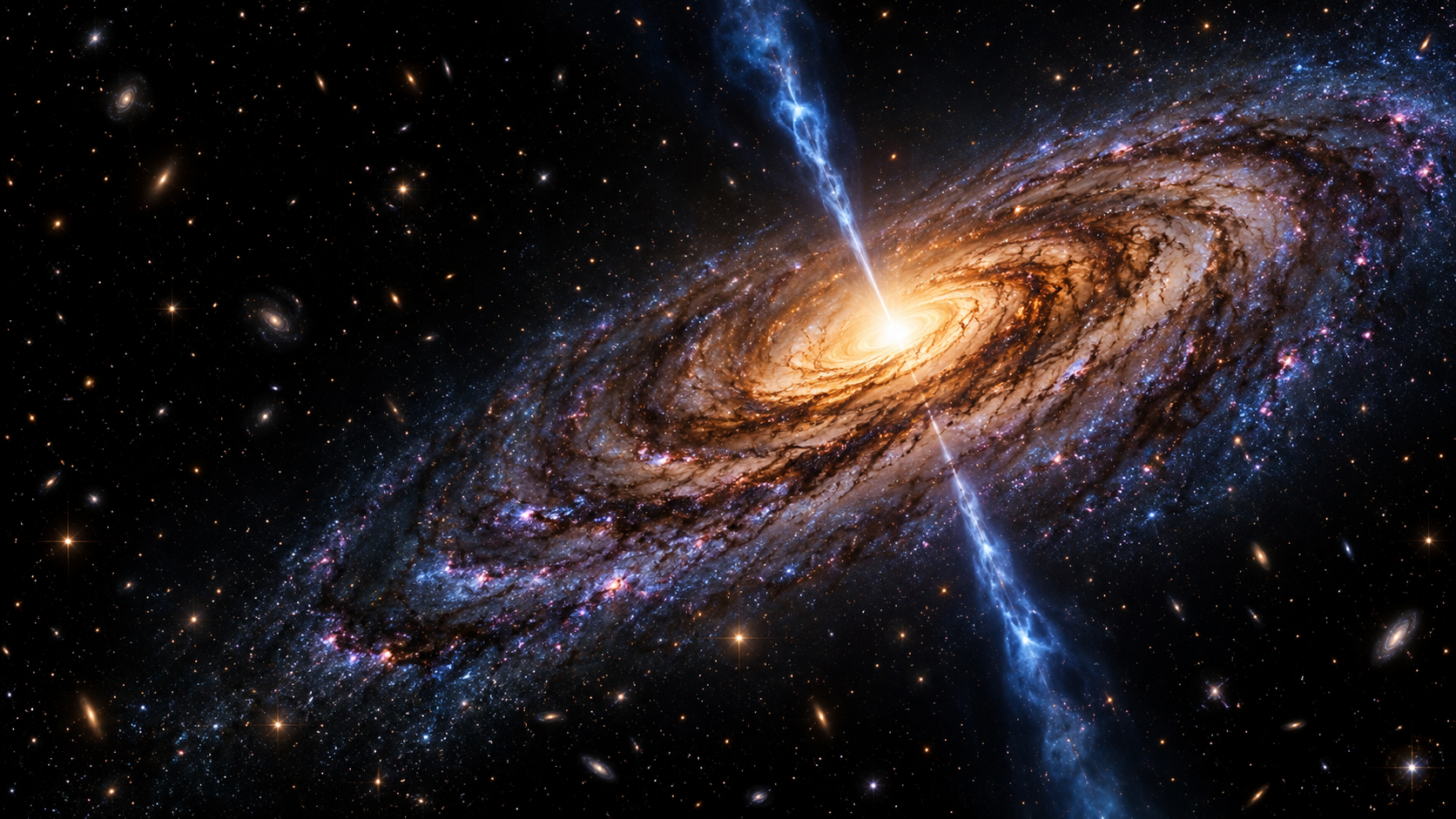
Discover how supermassive black holes form, grow, and interact with their host galaxies through active galactic nuclei, quasars, and feedback mechanisms.
Galaxies are often seen as vast, self-contained “islands” of stars. Yet, at the centers of many galaxies, there are supermassive black holes—objects with masses ranging from millions to billions of times that of the Sun. They do not behave like cosmic vacuum cleaners that consume everything around them. Their greatest influence appears when gas flows toward the galactic center, accretion begins, and the system becomes an exceptionally energetic active galactic nucleus.
The study of supermassive black holes brings together general relativity, astrophysics, galaxy formation, and the history of the early Universe. Their origin has not yet been fully explained, but it is already clear that their growth and the evolution of galaxies are deeply interconnected.
A supermassive black hole does not control an entire galaxy through its direct gravitational pull. Its primary influence comes from the radiation, winds, and relativistic jets generated during the accretion process.
What Is a Supermassive Black Hole?
Supermassive black holes are generally defined as black holes with masses of at least hundreds of thousands of solar masses, although the observed examples often contain millions or billions of solar masses. They are primarily found at the centers of galaxies.
A black hole itself does not emit light. However, matter falling toward it can first form an extremely hot accretion disk. Friction between particles and magnetic interactions within this disk can make it exceptionally luminous, producing radio, optical, ultraviolet, X-ray, and gamma-ray radiation.
When this radiation exceeds the combined brightness of the host galaxy’s stars, the system is observed as an active galactic nucleus. Quasars are among the brightest types of active galactic nuclei.
In 2019, the Event Horizon Telescope collaboration obtained the first horizon-scale image of radiation surrounding the central black hole in the galaxy M87. The observations revealed a ring of light around the black hole’s shadow and indicated a mass of approximately 6.5 billion solar masses. [1]
What Are Quasars? (Quasi-Stellar Objects)
Quasars are not black holes themselves. They are the exceptionally luminous active nuclei of distant galaxies, powered by supermassive black holes that are rapidly accreting gas and dust. As matter spirals inward through a hot accretion disk, gravitational energy is converted into intense radiation across the electromagnetic spectrum.
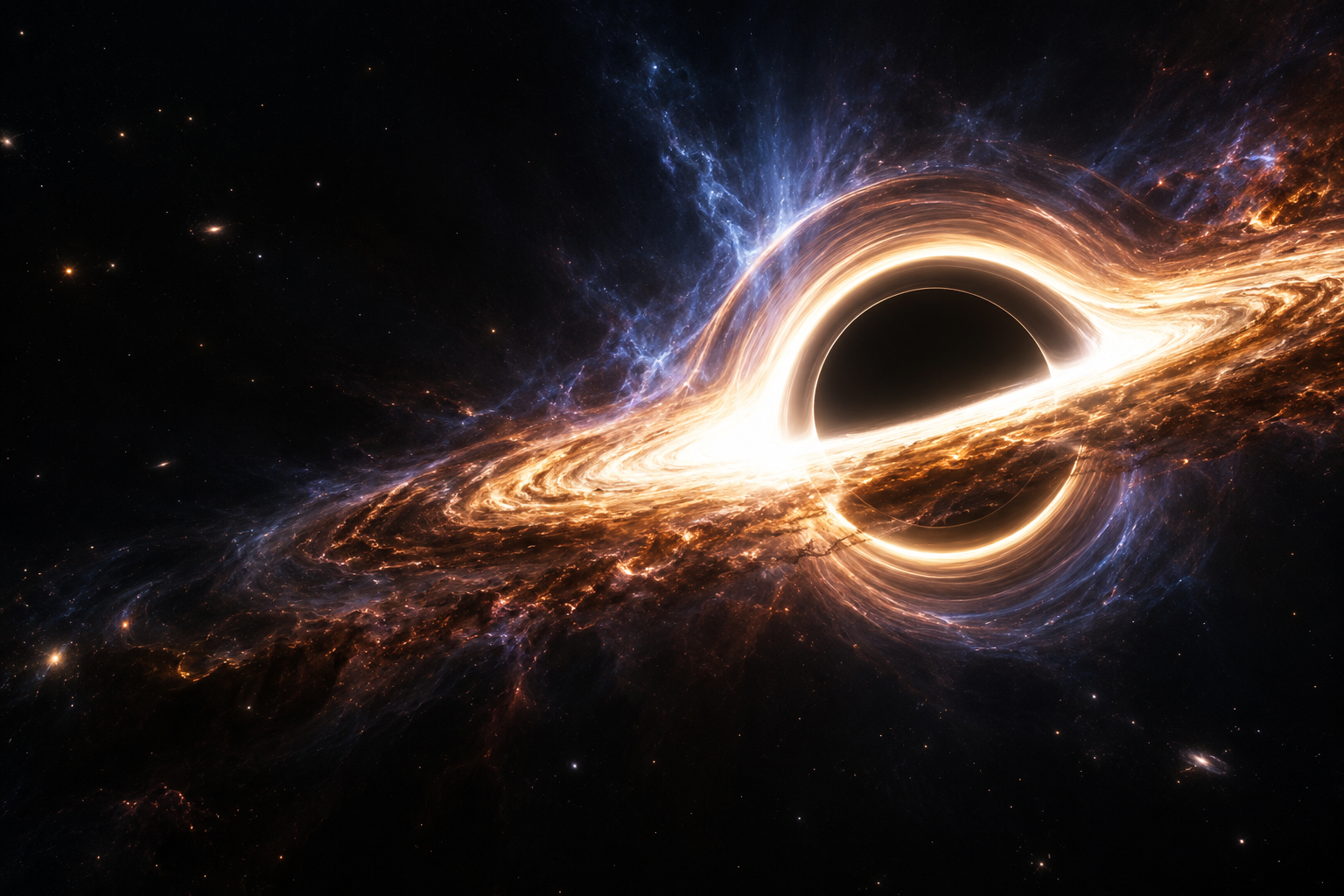
At their brightest, quasars can outshine all the stars in their host galaxies combined. Some also produce narrow, high-energy relativistic jets that extend far beyond the galaxy. Because many quasars are observed at extreme distances, they provide a unique view of the early Universe and the rapid growth of its first supermassive black holes. [6]
The Origin Mystery: How Did the First Black Holes Form?
One of the most difficult questions concerning supermassive black holes is how they managed to grow so rapidly in the early Universe.
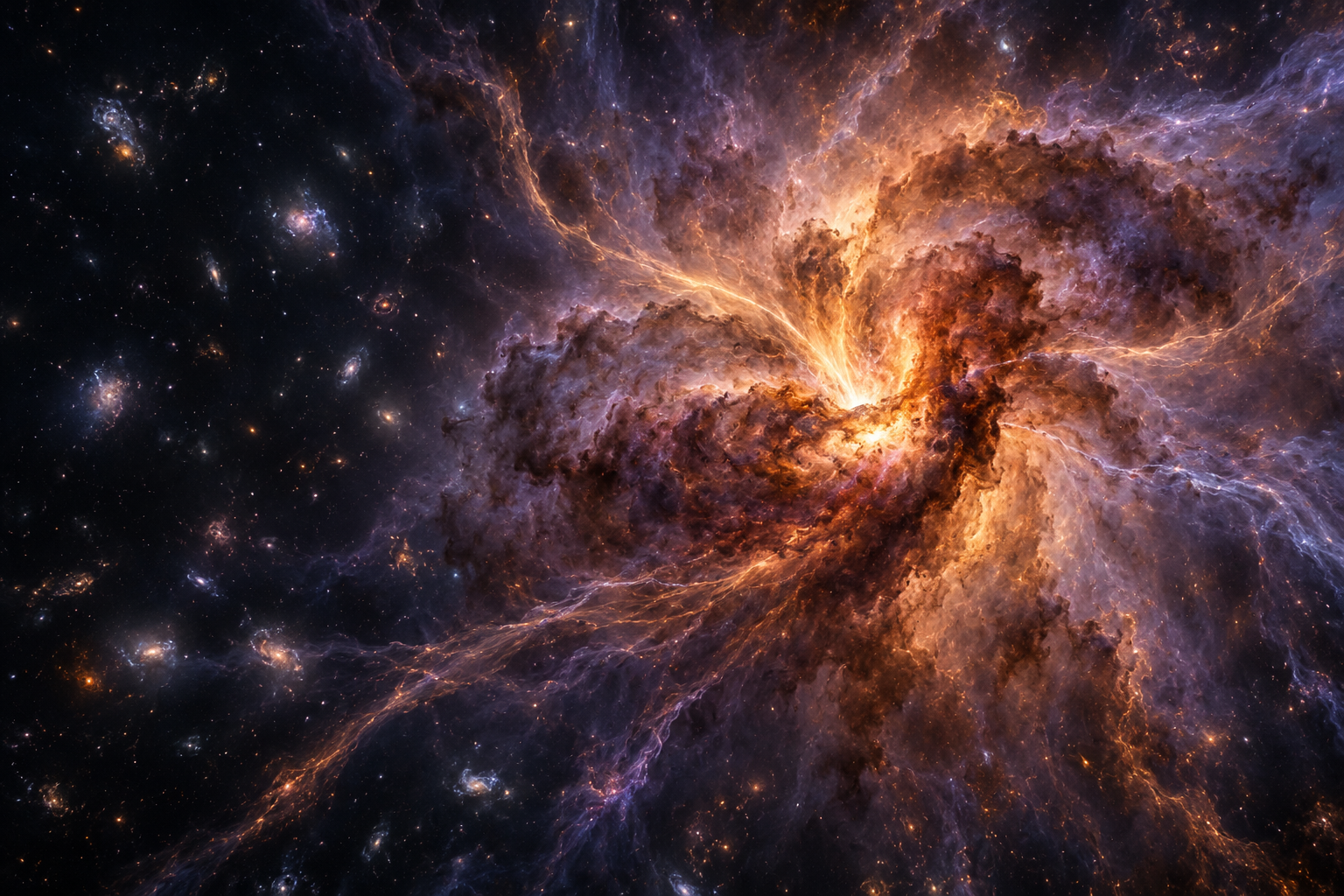
Astronomers have observed quasars whose central black holes already possessed hundreds of millions or billions of solar masses when the Universe was only around 700 million years old. For example, the quasar J1342+0928 hosts a black hole with an estimated mass of approximately 800 million solar masses, despite being observed when the Universe was only 690 million years old. [4] The quasar Pōniuā‘ena contains a black hole of about 1.5 billion solar masses at a cosmic age of roughly 700 million years. [5]
These masses are difficult to explain through continuous, rate-limited accretion beginning only from small stellar remnants. For this reason, several major formation scenarios are under consideration.
Light Seeds
In the light-seed scenario, the first black holes formed from the collapse of the first generation of stars, known as Population III stars. These seeds may have had masses ranging from tens to hundreds of solar masses.
They would then have grown through gas accretion and mergers with other black holes. The main challenge of this model is time: reaching the observed masses of early quasars would require extremely efficient growth or brief episodes of super-Eddington accretion.
Heavy Seeds
In heavy-seed models, massive and metal-poor gas clouds in the early Universe could collapse directly without first forming an ordinary generation of stars. This process could create initial black holes with masses of approximately 10⁴ to 10⁶ solar masses.
Such an early advantage would make later growth considerably easier. However, direct collapse requires specific conditions, including rapid gas inflow, suppressed molecular cooling, and a suitable radiation environment. [3]
The source UHZ1, detected through observations by the James Webb Space Telescope and the Chandra X-ray Observatory at a redshift of approximately z ≈ 10.3, is considered an important candidate consistent with the heavy-seed model. However, a single observation does not prove that any one seed-formation scenario is exclusively correct. [7]
The Co-Evolution of Galaxies and Black Holes
One of the most important pieces of evidence connecting supermassive black holes to galaxies is the M(BH)–σ relation. This relationship shows that the mass of a central black hole, M(BH), is correlated with the velocity dispersion, σ, of stars in the galaxy’s bulge.
In simplified form:
M(BH) ∝ σ⁴–⁵
This relationship is significant because the event horizon of a black hole is extremely small compared with the scale of a galaxy. Nevertheless, the mass of the central black hole is connected to the dynamics of a stellar bulge extending across thousands of light-years. [8]
However, this correlation should not be interpreted as direct proof of a simple one-way cause-and-effect relationship. It suggests the possibility of co-evolution or shared growth pathways, but it does not prove that every galaxy is regulated only by black hole feedback. Galaxy mergers, star formation, dark-matter halos, and observational selection effects may also contribute.
In addition, the strength of the relationship differs among classical bulges, pseudobulges, and bulgeless galaxies. [9]
Active Galactic Nuclei and Feedback
A supermassive black hole can have its greatest impact during an active phase. When large quantities of gas flow toward the center, the accretion disk releases enormous amounts of energy, and magnetic fields can sometimes produce high-velocity jets.
Together, these processes are known as active galactic nucleus, or AGN, feedback.
Radiative or Quasar Mode
During periods of high accretion, radiation from a quasar and the winds associated with it can affect the cold gas within a galaxy. In some cases, they can accelerate or expel gas, reducing the material available for new star formation and limiting the black hole’s future fuel supply.
Observing this mode directly is challenging because astronomers must distinguish the effects of an AGN from those of starbursts, supernovae, and the surrounding galactic environment. [10]
Kinetic or Jet Mode
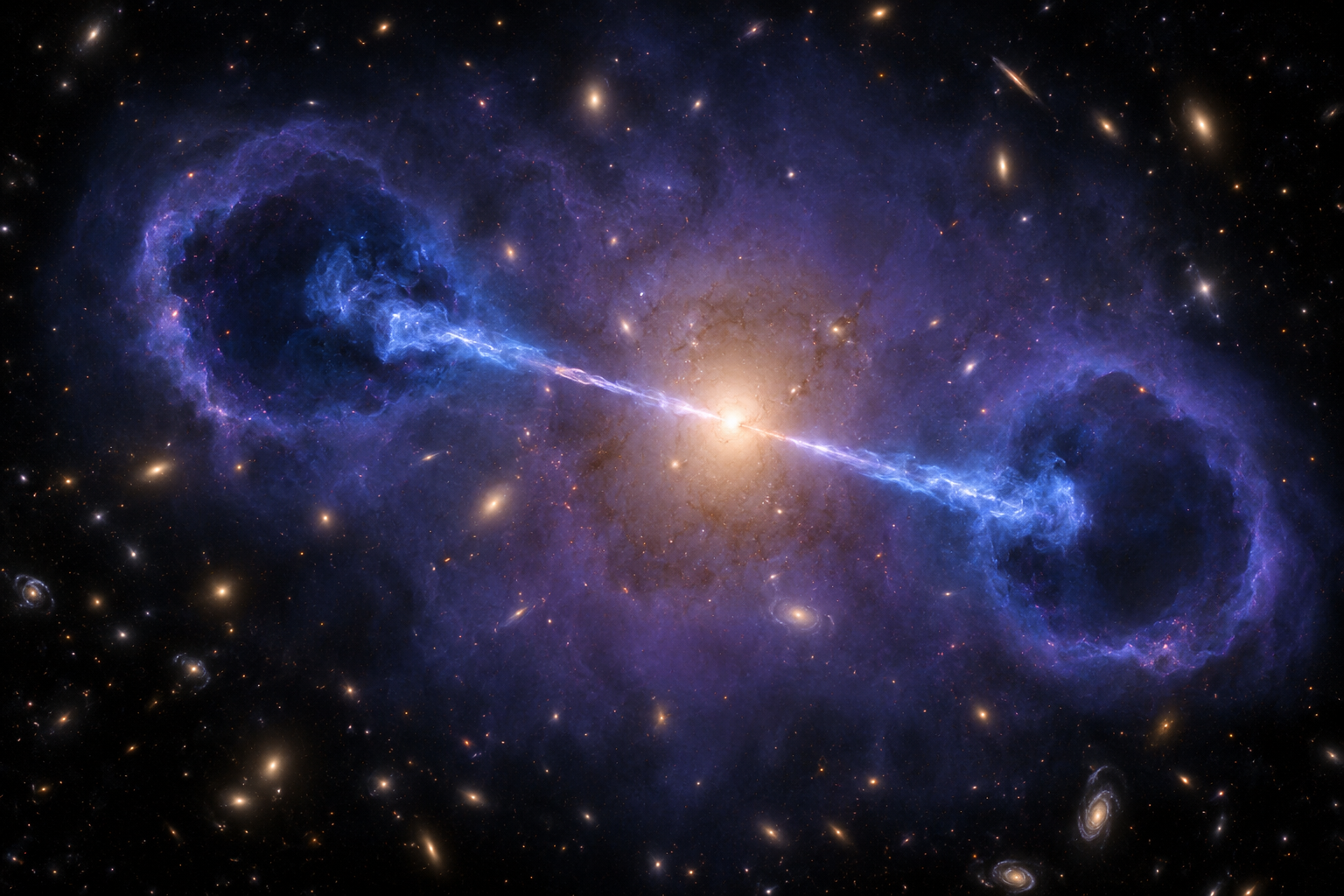
Some active galactic nuclei produce narrow relativistic jets. These jets can travel thousands or even millions of light-years and heat the surrounding hot gas.
This process is particularly well studied in the centers of galaxy clusters, where radio jets create cavities or “bubbles” in X-ray-emitting gas. This mechanism can slow gas cooling and reduce future star formation. [10]
At the same time, feedback does not always suppress star formation. Under certain conditions, shock waves can compress gas and trigger localized star formation. Therefore, the effect of AGN feedback depends on galaxy mass, gas distribution, the duration of the active phase, and the external environment.
Do Black Holes “Quench” Galaxies?
The decline or quenching of star formation in galaxies cannot be explained by a single factor. Supernova feedback, gas depletion, gas stripping in dense environments, and AGN activity may all contribute.
Nevertheless, supermassive black hole feedback is considered an important mechanism, especially in massive galaxies and central galaxies within galaxy clusters. It helps explain why many large galaxies do not form stars at the rate expected from the total amount of gas available in their halos.
Scientific research also cautions that directly comparing the energy of observed AGN outflows with the suppression of star formation often depends on model assumptions. Therefore, AGN feedback is more accurately described as an important but neither universal nor automatic “switch” for galaxy evolution. [11]
The Milky Way and Andromeda: A Local Laboratory
At the center of the Milky Way lies the supermassive black hole Sagittarius A*, or Sgr A*. Its mass is approximately 4.3 million solar masses. Precise measurements of the orbits of S-stars and the motion of gas near the Galactic center show that this mass is concentrated within an extremely small region. [2]
Sagittarius A* is currently relatively quiet. It accretes little matter and does not display quasar-like activity. However, it may have experienced more active phases in the past.
The central black hole of the Andromeda Galaxy, M31, is more massive. Different dynamical measurements have produced estimates ranging from several tens of millions to roughly one hundred million solar masses. One detailed model estimated its mass at approximately 5 × 10⁷ solar masses. [12]
For many years, astronomers believed that the Milky Way and Andromeda would almost certainly merge in approximately four to five billion years. However, a study published in 2025—which also accounts for the dynamical influence of the Large Magellanic Cloud and the Triangulum Galaxy, M33—showed that the probability of a merger during the next 10 billion years remains significantly uncertain. [13]
If the two galaxies do merge in the future, their central black holes are expected to form a bound pair. Their eventual approach and possible merger would depend on the loss of angular momentum through interactions with stars, gas, and gravitational waves. This process should not be described as immediate or completely predetermined.
Conclusion
Supermassive black holes are not merely dark gravitational objects. During active phases, they can alter the temperature, motion, and availability of gas, thereby influencing the star-formation history of their host galaxies.
However, galaxy evolution is a multi-factor process. Supermassive black holes are an important part of that process, not its only explanation. The origin of black hole seeds, the pathways of rapid growth, the true efficiency of feedback, and the nature of black hole–galaxy co-evolution remain among the most active areas of modern astrophysical research.
Scientific Sources
[1] Event Horizon Telescope Collaboration — First M87 Event Horizon Telescope Results. VI: The Shadow and Mass of the Central Black Hole
The Astrophysical Journal Letters, 2019
[2] Max Planck Institute for Extraterrestrial Physics — Ultracompact: The Black Hole at the Center of Our Milky Way
MPE, 2023
[3] Volonteri, Habouzit & Colpi — The Origins of Massive Black Holes
Nature Reviews Physics, 2021
[4] Bañados et al. — An 800-Million-Solar-Mass Black Hole in a Significantly Neutral Universe at a Redshift of 7.5
Nature, 2018
[5] Yang et al. — Pōniuā‘ena: A Luminous z = 7.5 Quasar Hosting a 1.5 Billion Solar Mass Black Hole
The Astrophysical Journal Letters, 2020
[6] ESA Euclid — Euclid Discovers the Most Ancient Quasar in the Universe
European Space Agency, 2026
[7] Bogdán et al. — Evidence for Heavy-Seed Origin of Early Supermassive Black Holes from a z ≈ 10 X-ray Quasar
Nature Astronomy, 2024
[8] Ferrarese & Merritt — A Fundamental Relation Between Supermassive Black Holes and Their Host Galaxies
The Astrophysical Journal Letters, 2000
[9] Kormendy & Ho — Coevolution (Or Not) of Supermassive Black Holes and Host Galaxies
Annual Review of Astronomy and Astrophysics, 2013
[10] Fabian — Observational Evidence of Active Galactic Nuclei Feedback
Annual Review of Astronomy and Astrophysics, 2012
[11] Harrison et al. — AGN Outflows and Feedback Twenty Years On
Nature Astronomy, 2018
[12] Menezes, Steiner & Ricci — Discovery of an Hα Emitting Disk Around the Supermassive Black Hole of M31
The Astrophysical Journal Letters, 2013
[13] Sawala et al. — No Certainty of a Milky Way–Andromeda Collision
Nature Astronomy, 2025