
Exoplanets: Discovering Other Worlds and the Search for Life Beyond Earth
Exoplanets reveal the diversity of worlds beyond the Solar System and guide the scientific search for habitable environments and life.
Share this story
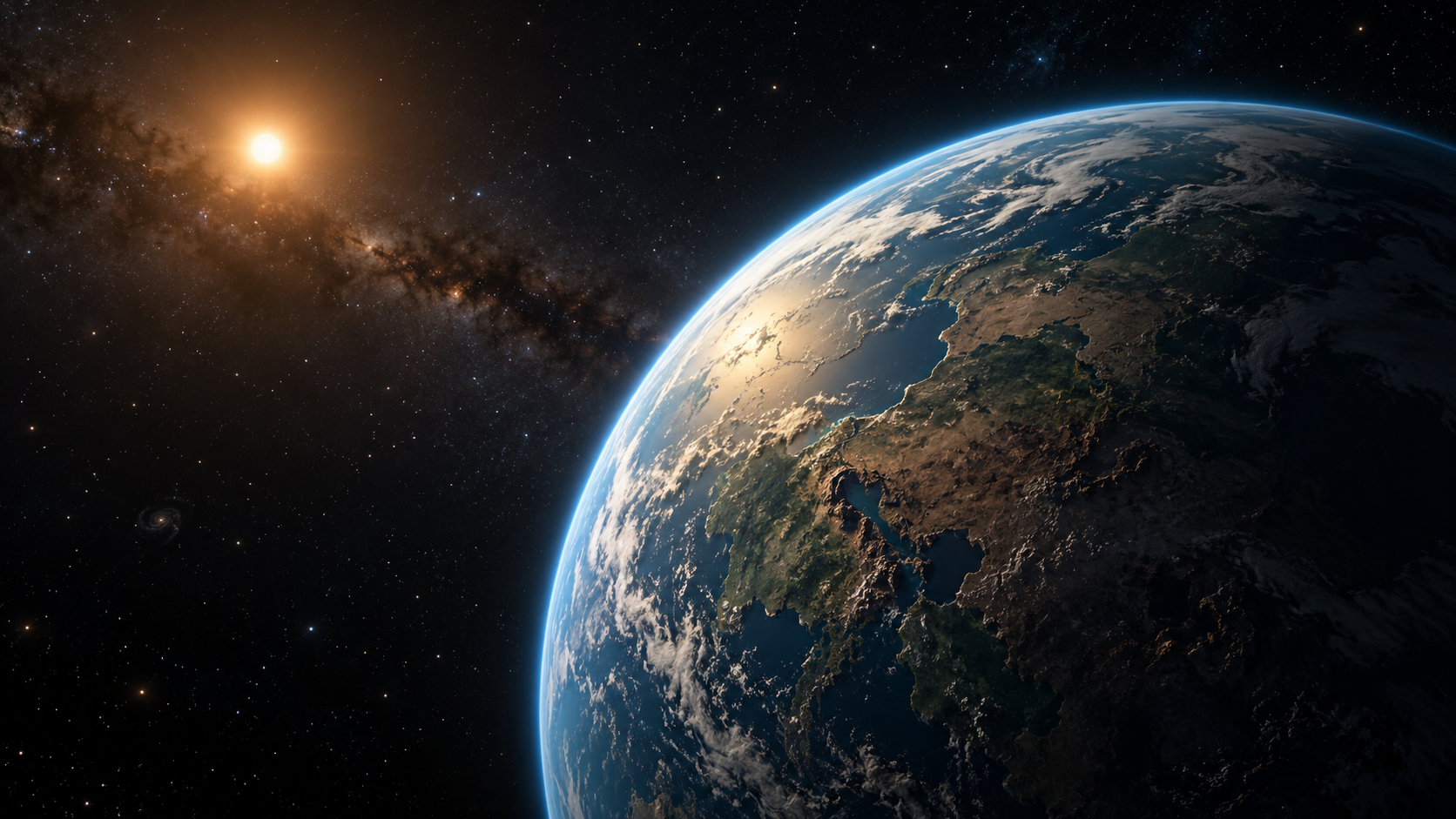
For a long time, the Solar System was considered the only accessible example of a planetary system. Today, that view has changed completely. Astronomers have discovered thousands of worlds orbiting other stars, ranging from scorching gas giants to rocky planets similar in size to Earth.
According to NASA’s Exoplanet Archive, more than 6,400 exoplanets had been confirmed by October 2026. Yet this number is only the beginning. The Milky Way contains hundreds of billions of stars, and planetary systems appear to be a natural outcome of star formation rather than a cosmic exception. [1]
The study of exoplanets brings together astronomy, planetary science, chemistry, atmospheric physics, and astrobiology. Its central question is simple, yet profoundly difficult: is Earth unique, or could life-friendly environments exist on other worlds?
The Exoplanet Revolution
An exoplanet is a planet located outside the Solar System. In 1995, Michel Mayor and Didier Queloz announced the discovery of 51 Pegasi b, one of the first confirmed planets orbiting a Sun-like star. This discovery transformed our understanding of planetary systems and later contributed to their Nobel Prize in Physics. [2]
The first discoveries often did not resemble our Solar System. For example, 51 Pegasi b is a “hot Jupiter,” a gas giant that orbits extremely close to its star and completes one year in only a few days. Its discovery showed that planetary formation and migration can produce systems very different from the one surrounding the Sun.
The Transit Method
A transit occurs when a planet passes in front of its star from our point of view, blocking a small fraction of the star’s light. Repeated dips in brightness can reveal the presence of a planet.
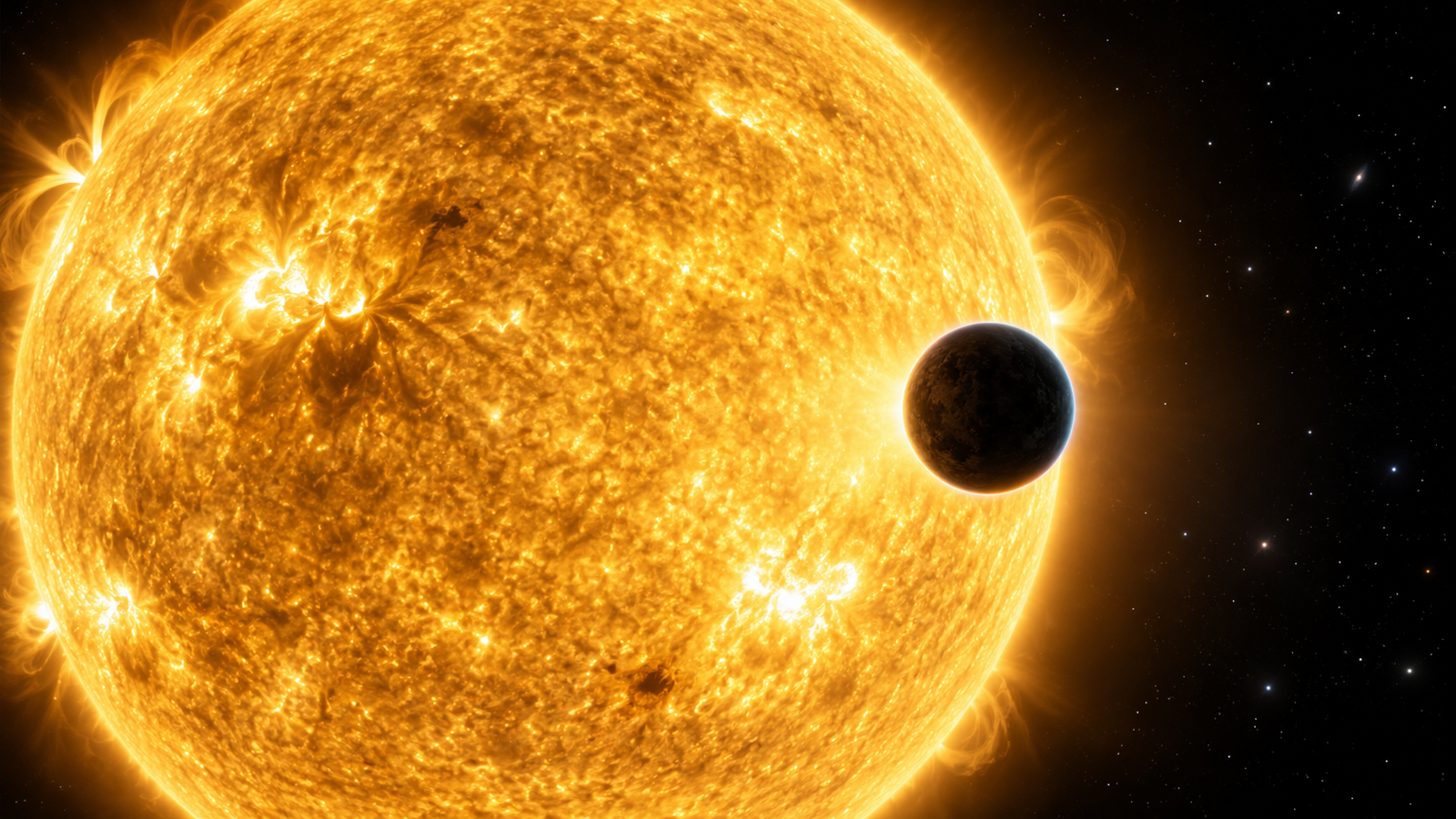
This method primarily measures a planet’s radius. It is especially effective for large planets and for planets orbiting small stars. However, it has an important limitation: the planet’s orbit must be aligned precisely with our line of sight. Many planets do not transit from Earth’s perspective and therefore remain undetectable by this method. [3]
The Radial Velocity Method
A planet does not simply orbit its star; its gravity also causes the star to move slightly. As the star moves toward Earth, its light shifts very slightly toward blue wavelengths. As it moves away, the light shifts toward red wavelengths.
By measuring this Doppler shift, astronomers can estimate a planet’s mass. In many cases, however, they determine only a minimum mass, expressed as M × sin i, because the orbital inclination may not be known precisely.
Direct Imaging and Microlensing
Direct imaging is one of the most difficult techniques because a star can be billions of times brighter than its planet. Using coronagraphs and advanced data-processing methods, astronomers attempt to block or reduce the star’s glare and detect the faint light from the planet itself.
Gravitational microlensing is based on Einstein’s theory of general relativity. When a foreground star passes in front of a more distant star, its gravity can magnify the background star’s light. If the foreground star has a planet, an additional short-lived signal may appear in the light curve. This method is valuable for detecting distant, cold planets, but such events are usually not repeatable.
The Diversity of Planetary Worlds
Exoplanetary systems have shown that the Solar System is not a universal model. Astronomers have found hot Jupiters, super-Earths, mini-Neptunes, planets in multi-star systems, and candidates for free-floating planets.
Especially interesting are planets between one and four Earth radii. Some may be rocky, while others possess thick gaseous or vapor-rich envelopes. Mini-Neptunes have no equivalent in our Solar System, yet they appear to be common around other stars. [4]
This provides an important lesson: a planet’s size alone does not reveal its true nature. A world only slightly larger than Earth could be rocky, ocean-covered, wrapped in a dense atmosphere, or a small gas-rich planet. Understanding its composition requires additional information about its mass, density, stellar radiation, and atmosphere.
The Habitable Zone: Necessary but Not Sufficient
The habitable zone is the region around a star where liquid water could exist on a planet’s surface under suitable atmospheric pressure. This concept is important because liquid water is the essential solvent for life as we know it. [5]
However, being located in the habitable zone does not mean that a planet is habitable or that it contains life. Actual conditions depend on many factors:
- Atmospheric thickness and chemical composition
- Greenhouse warming
- Planetary mass and gravity
- Magnetic field strength
- Stellar activity
- Rotation and orbital shape
- Water and volatile-element inventory
- Long-term geological stability
For example, Venus lies near the inner edge of the Sun’s habitable zone, yet its dense carbon-dioxide atmosphere has produced an extreme greenhouse effect.
Mars, by contrast, has a very thin and cold atmosphere today, so liquid water cannot remain stable on its surface for extended periods. However, billions of years ago, Mars likely had a denser atmosphere, rivers, lakes, and perhaps even oceans. For this reason, scientists search for chemical or biological traces of ancient life, as well as possible subsurface environments where conditions suitable for life may have persisted for longer.
Red dwarf stars are especially interesting because they are common and because transits of small planets are easier to observe around them. At the same time, red dwarfs can be highly active, producing intense ultraviolet and X-ray flares that may strip atmospheres away or alter their chemistry. Tidal locking is also possible, but it does not automatically rule out habitability if an atmosphere or ocean can redistribute heat between the planet’s day and night sides.
How Do We Read an Exoplanet Atmosphere?
The main tool for studying planetary atmospheres is spectroscopy. Each chemical compound absorbs light at specific wavelengths, leaving a distinctive spectral fingerprint.
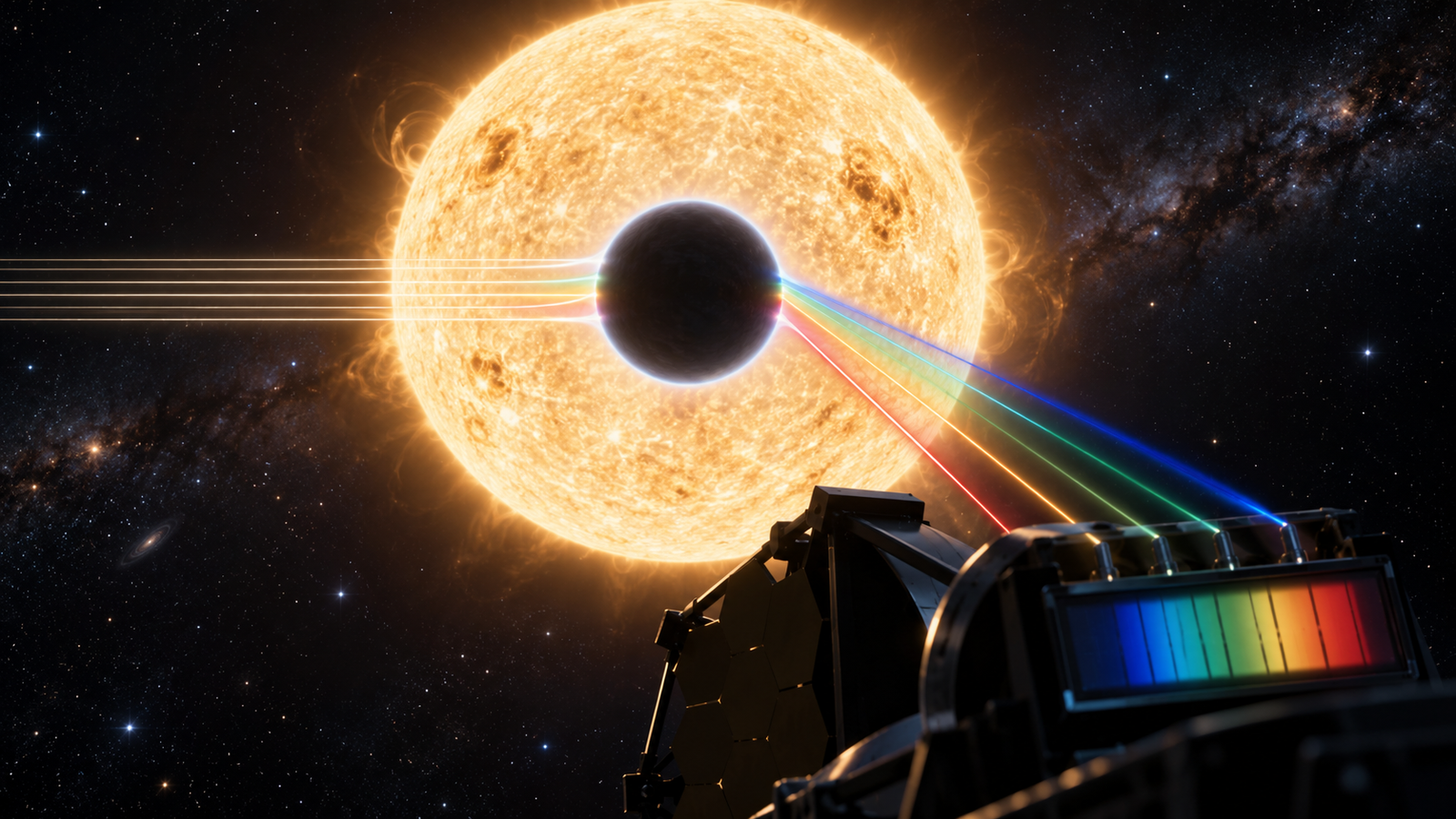
During a transit, some starlight passes through the edge of a planet’s atmosphere. If the atmosphere contains water vapor, carbon dioxide, methane, or other molecules, they alter the observed spectrum. This method is known as transmission spectroscopy.
Astronomers also use other approaches:
- Secondary-eclipse spectroscopy, when a planet passes behind its star
- Thermal-emission measurements
- Phase curves, which track light from different sides of a planet
- Direct imaging of reflected or infrared planetary light
One of the James Webb Space Telescope’s major achievements was the clear detection of carbon dioxide in the atmosphere of the gas giant WASP-39 b. This is not evidence of life, since WASP-39 b is an extremely hot gas giant. However, the result demonstrated that modern instruments can identify the atmospheric chemistry of distant worlds with high confidence. [6]
Biosignatures: Why One Molecule Is Not Enough
A biosignature is an observable feature that may indicate biological activity. The most frequently discussed molecules include oxygen, ozone, methane, nitrous oxide, and certain sulfur-bearing compounds.
However, detecting a single gas is not proof of life.
Oxygen is abundant in Earth’s atmosphere largely because of photosynthesis, but it can also form through non-biological processes on other planets. For example, intense stellar radiation can split water molecules, allowing hydrogen to escape into space while oxygen remains in the atmosphere. Methane can also be produced by both biological and geological processes.
For this reason, scientists look not for one gas alone, but for the broader planetary context:
- The presence of several gases together
- Chemical disequilibrium in the atmosphere
- The host star’s ultraviolet radiation
- Planetary mass, radius, and density
- Possible surface oceans or geological activity
- The exclusion of plausible non-biological sources
Key point: Detecting oxygen, methane, or water in an atmosphere is scientifically important, but it does not by itself confirm the presence of life. [7]
TRAPPIST-1 and K2-18 b: Promising but Uncertain Worlds
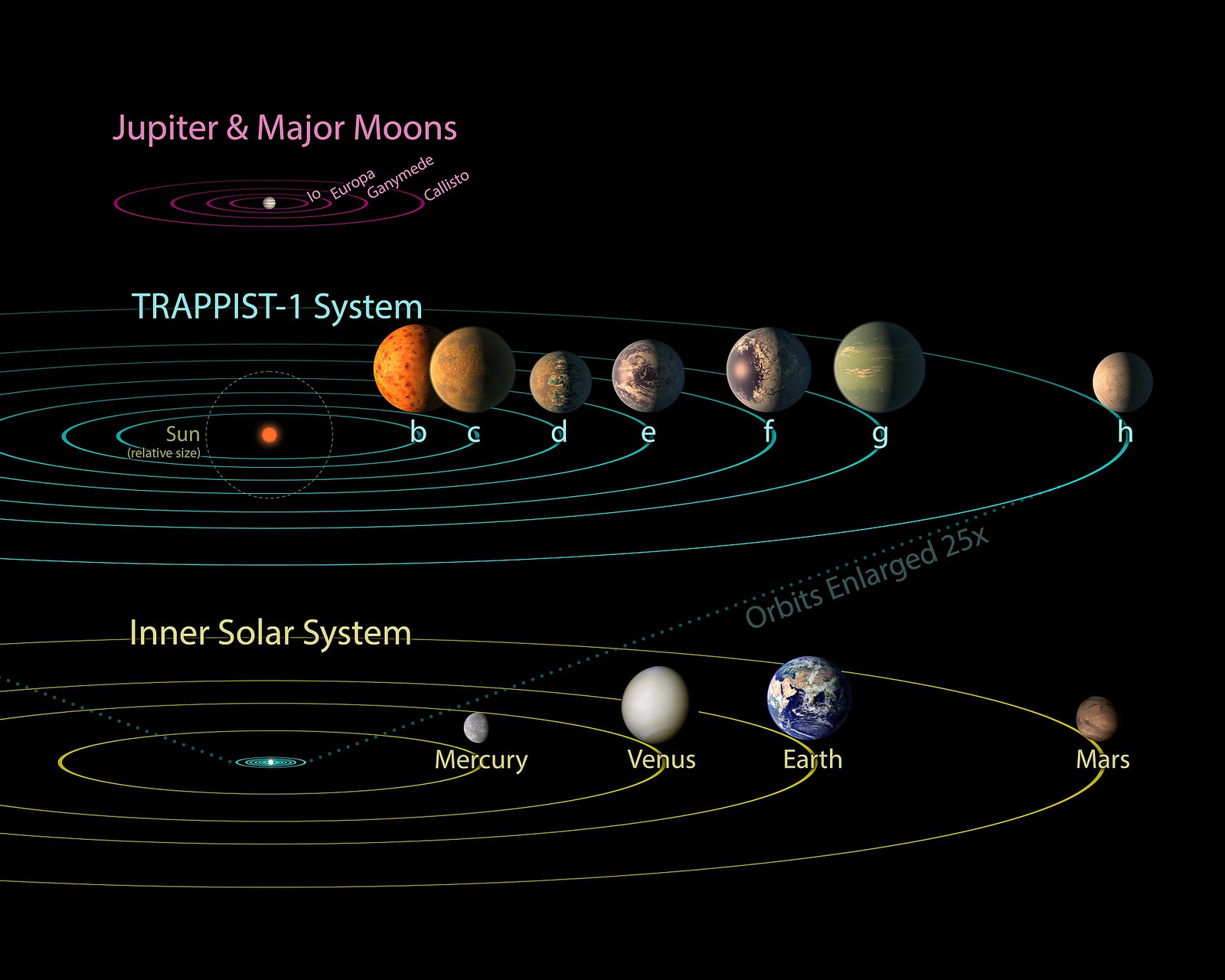
The TRAPPIST-1 system contains seven planets roughly similar in size to Earth, several of which orbit near the star’s theoretical habitable zone. It has become one of the most important laboratories for studying small, rocky exoplanets.
However, James Webb observations also show why caution is necessary. Data for TRAPPIST-1 c are inconsistent with a thick, carbon-dioxide-rich atmosphere similar to that of Venus. This does not mean that the system’s other planets lack atmospheres, but it highlights the difficulty small planets may face in retaining volatile compounds around active stars. [8]
K2-18 b orbits within the habitable zone of its red dwarf star. James Webb data have been interpreted as showing methane and carbon dioxide, and the planet has been discussed as a possible “Hycean” world—a theoretical class of planet with a hydrogen-rich atmosphere and a potential global ocean. [9]
However, K2-18 b is not an Earth-like rocky planet. It is a sub-Neptune with a mass approximately 8.6 times that of Earth. Claims involving a possible dimethyl sulfide signal remain debated, and an independent reanalysis concluded that there is currently no statistically significant evidence for a biosignature in its atmosphere. [10]
This example demonstrates the strength of the scientific method: extraordinary claims require independent observations, repeated measurements, and careful testing of alternative explanations.
The Next Generation of Telescopes
Exoplanet science is entering a new phase. NASA’s TESS mission continues to search for transiting planets around nearby, bright stars that are suitable for detailed follow-up observations. [11]
ESA’s PLATO mission, planned for launch in 2027, will focus on finding rocky planets in the habitable zones of Sun-like stars and characterizing their host stars with high precision. The Ariel mission, planned for 2029, will study the atmospheres of a large and diverse population of exoplanets through spectroscopy. [12] [13]
Looking further ahead, NASA’s proposed Habitable Worlds Observatory aims to directly image potentially habitable planets around nearby stars and study their atmospheres for possible biosignatures. Its scientific goal includes the direct observation of approximately 25 potentially habitable worlds. [14]
Conclusion
The discovery of exoplanets has revealed that planetary diversity is far greater than humanity imagined only a few decades ago. We can now measure the radii, masses, densities, temperatures, and, in some cases, atmospheric chemistry of distant worlds.
Yet the search for life remains at its most challenging stage. A habitable-zone orbit, water vapor, or even a biologically associated molecule is not enough on its own. Real progress will come from studying atmospheres, host stars, geological environments, and chemical balance together.
At present, there is no confirmed evidence of life beyond Earth. But exoplanet science has already provided one of the most important answers in modern astronomy: planets are common throughout the Universe, and the question of how common habitable worlds may be is no longer only philosophical—it is now a measurable scientific problem.
Sources
[1] NASA Exoplanet Archive — Confirmed Planets and Statistics
[2] Mayor & Queloz (1995) — A Jupiter-Mass Companion to a Solar-Type Star
[3] NASA Science — How We Find and Characterize Exoplanets
[4] Marcy et al. (2014) — Occurrence and Core-Envelope Structure of 1–4 Earth-Size Planets
[5] Kopparapu et al. (2013) — Habitable Zones Around Main-Sequence Stars
[6] JWST Transiting Exoplanet Community Team (2023) — Carbon Dioxide in WASP-39 b
[7] Meadows et al. (2018) — Exoplanet Biosignatures and Oxygen
[8] Zieba et al. (2023) — No Thick Carbon Dioxide Atmosphere on TRAPPIST-1 c
[9] NASA — Webb Discovers Methane and Carbon Dioxide in K2-18 b
[10] Stevenson et al. (2025) — K2-18 b Does Not Meet the Standards of Evidence for Life
[11] NASA — Transiting Exoplanet Survey Satellite, TESS
[12] ESA — PLATO Mission