
Solar Storms and Space Weather: How the Sun Affects Earth
Solar storms can disrupt satellites, navigation, communications, aviation, and power grids on Earth.
Share this story
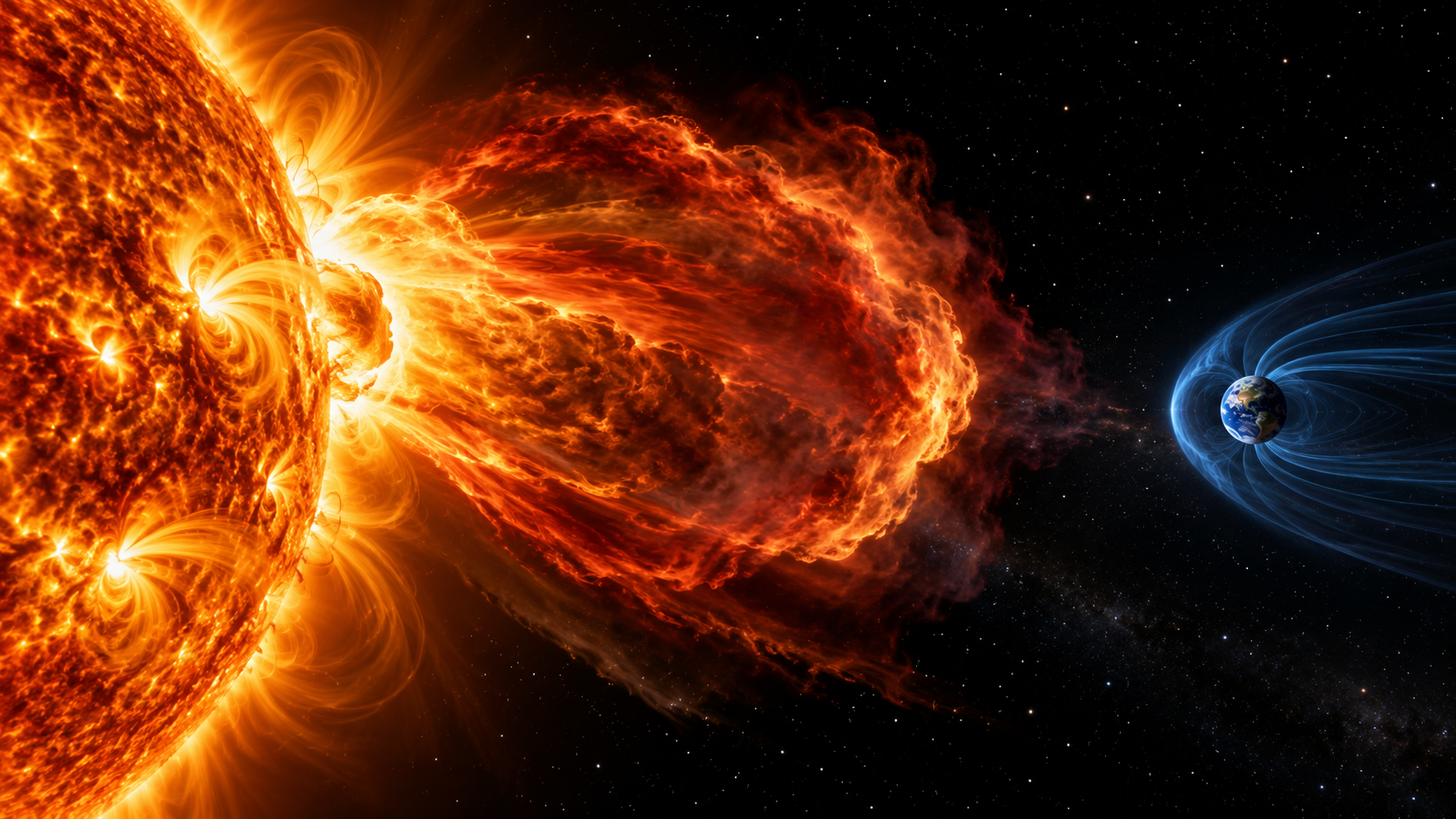
Discover how solar flares, coronal mass ejections, and charged particles create space weather, affecting auroras, satellites, GPS, aviation, and power grids.
Introduction
The Sun often appears to be a stable and unchanging source of light. In reality, it is a complex and dynamic plasma system. Enormous amounts of energy continually accumulate and reorganize within its magnetic field, sometimes being released through flares, particle acceleration, and massive eruptions of solar material.
The consequences of these processes are not only of astrophysical interest. They can affect satellites orbiting Earth, navigation systems, radio communications, aviation, power grids, and even long metal pipelines. The collection of these phenomena is known as space weather. [1]
It is important to make one distinction clear: solar storms do not usually pose a direct danger to people on Earth’s surface because the atmosphere and Earth’s magnetic field provide strong protection. The main risks concern technological infrastructure, high-altitude polar flights, and people or equipment operating in space. [2]
What Is Space Weather?
Space weather refers to changes in the solar wind, interplanetary magnetic field, Earth’s magnetosphere, ionosphere, and upper atmosphere that are driven by solar activity. [1]
It is not like ordinary weather on Earth. It does not involve rain, wind, or temperature at ground level. Instead, the main components of space weather include:
- Electromagnetic radiation
- High-energy protons and electrons
- Solar wind
- Plasma
- Magnetic fields
- Electrical currents in Earth’s magnetosphere and ionosphere
This system can be understood as a chain of events extending from the Sun to Earth:
Solar magnetic activity → radiation and plasma eruptions → magnetospheric disturbances → effects on technological systems.
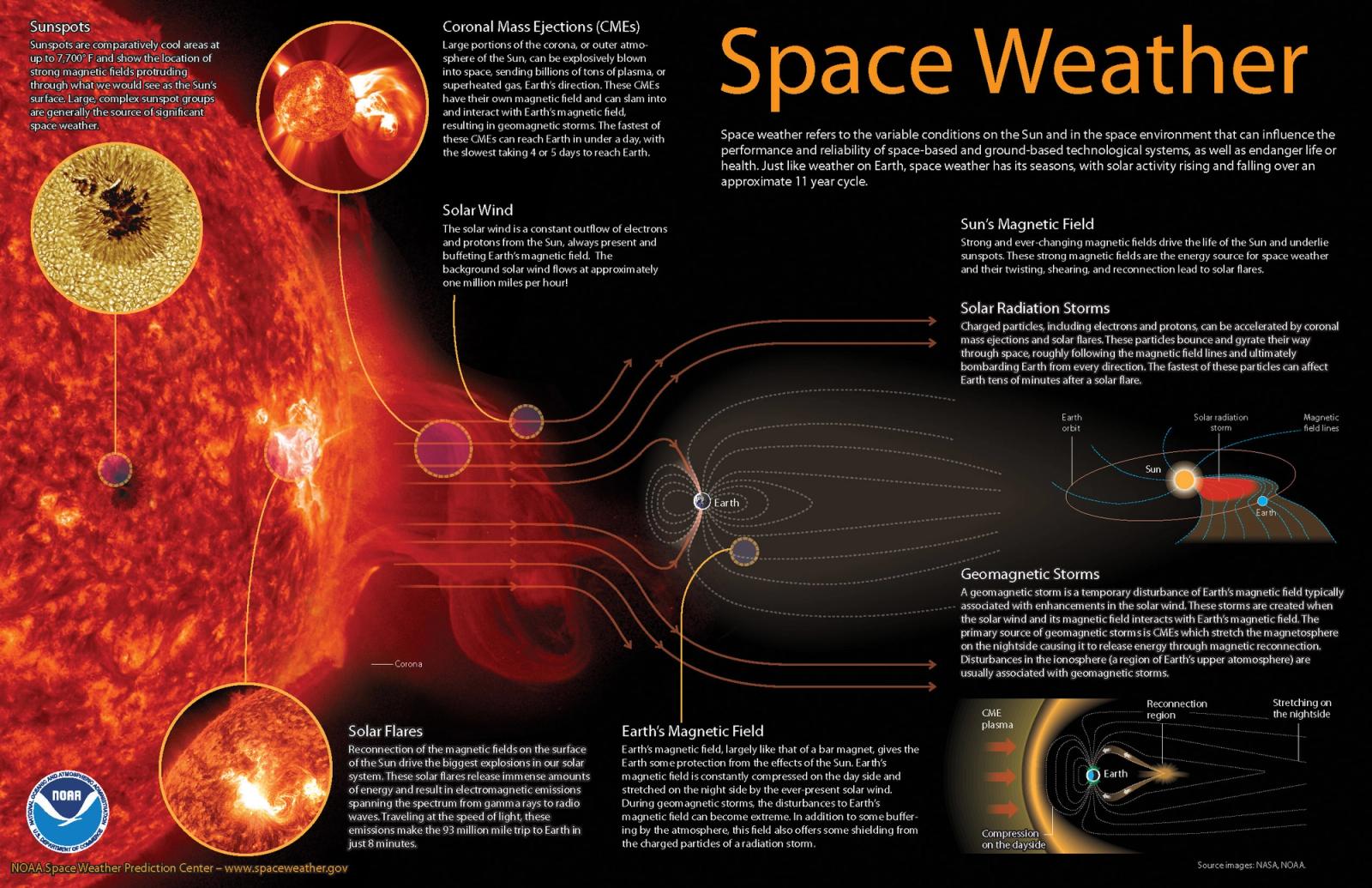
Solar Magnetic Activity
The Sun is made mostly of hydrogen and helium, but its outer layers are not ordinary gas. Because temperatures are extremely high, the material exists as plasma, containing freely moving ions and electrons. Plasma conducts electricity and interacts strongly with magnetic fields.
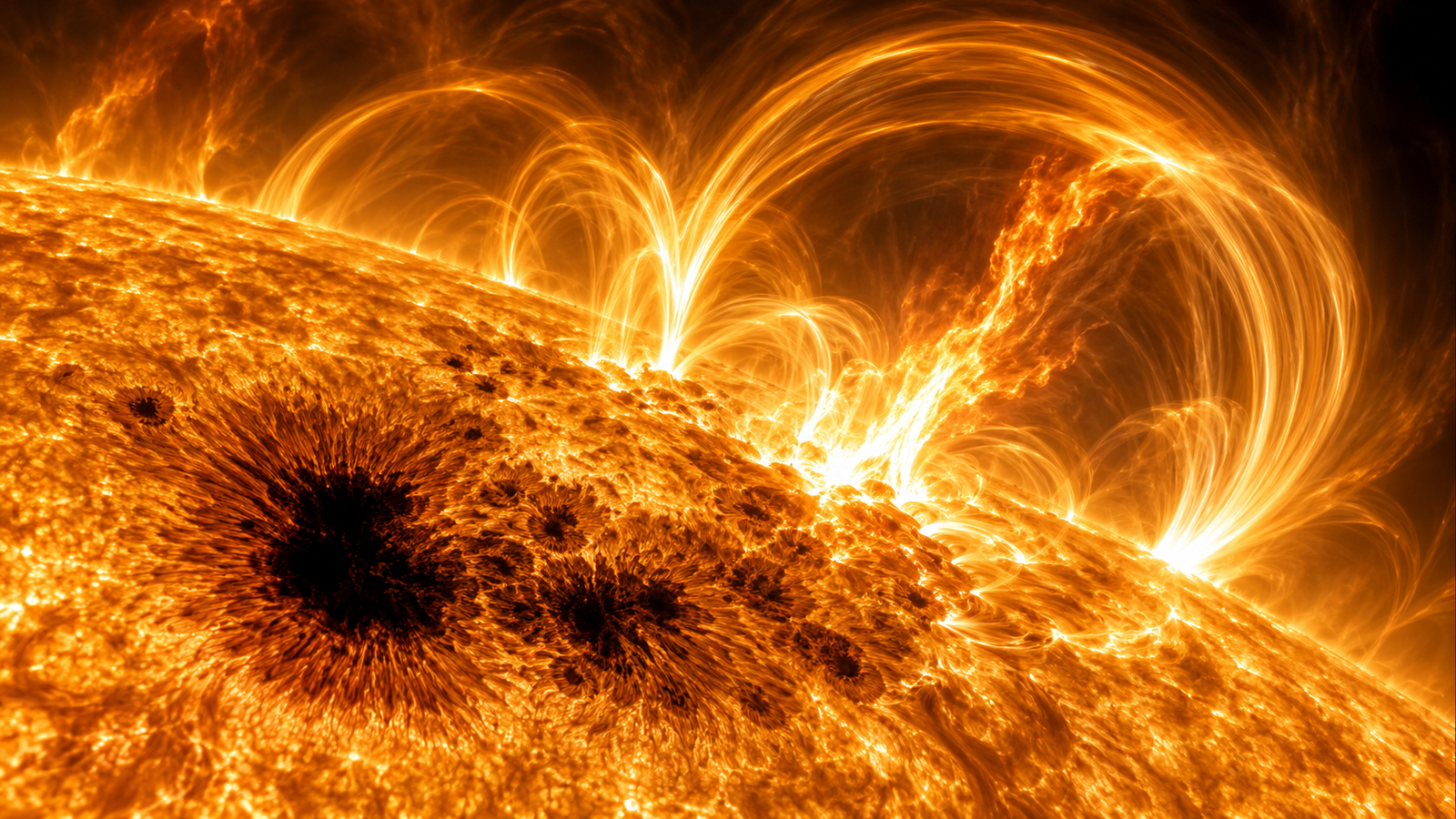
The Sun rotates on its axis, much like Earth. However, because it is a vast sphere of plasma rather than a solid body, it does not rotate at the same speed everywhere. Its equatorial regions rotate faster than its polar regions. Over time, this differential rotation stretches, twists, and strengthens the Sun’s magnetic field.
As a result, sunspots, active regions, and complex magnetic structures form. Large amounts of energy can accumulate within these regions before being released explosively.
Solar activity follows cycles lasting approximately 11 years. During periods of solar maximum, sunspots, flares, and coronal mass ejections become more frequent. However, these cycles are not perfectly regular. Their strength and duration vary, and predicting the exact timing of powerful events remains a difficult scientific challenge.
Solar Flares, Coronal Mass Ejections, and Particle Storms
Solar Flares
A solar flare is a rapid release of magnetic energy in the Sun’s atmosphere. It produces intense X-rays, ultraviolet radiation, visible light, and radio emissions.
Flare radiation travels at the speed of light and reaches Earth in approximately eight minutes. Powerful flares can quickly alter the state of Earth’s ionosphere, particularly on the sunlit side of the planet, causing short-term disruptions to high-frequency radio communication. [3]
Solar flares are classified as C, M, or X class based on their X-ray intensity. X-class flares are the most powerful. However, the flare classification alone does not determine the full level of impact on Earth.
Coronal Mass Ejections
A coronal mass ejection, or CME, is a massive eruption of plasma and magnetic field from the Sun’s outer atmosphere, known as the corona. A CME can carry billions of tons of material and travel at speeds of hundreds or even thousands of kilometers per second. [2]
A CME can reach Earth in as little as 15 hours or take several days, depending on its speed and conditions in interplanetary space. However, not every CME is dangerous to Earth. Significant effects occur only when an ejection is directed toward Earth and carries a magnetic field with a favorable orientation for coupling with Earth’s magnetic field.
Solar Energetic Particles
Solar flares and shock waves ahead of CMEs can accelerate protons and electrons to extremely high energies. These events are called solar energetic particle events, or SEPs.
The fastest particles can travel from the Sun to Earth in approximately 30 minutes. They are especially important for astronauts, future missions to the Moon and Mars, and aircraft crews on high-altitude polar routes. [2]
How Solar Storms Interact with Earth
Earth is surrounded by a magnetic field that creates a protective region called the magnetosphere. It deflects much of the solar wind and shields the atmosphere from direct exposure to charged particles. However, the magnetosphere is not an impenetrable barrier. It is a dynamic system that can be compressed, stretched, and reorganized by the solar wind. [4]
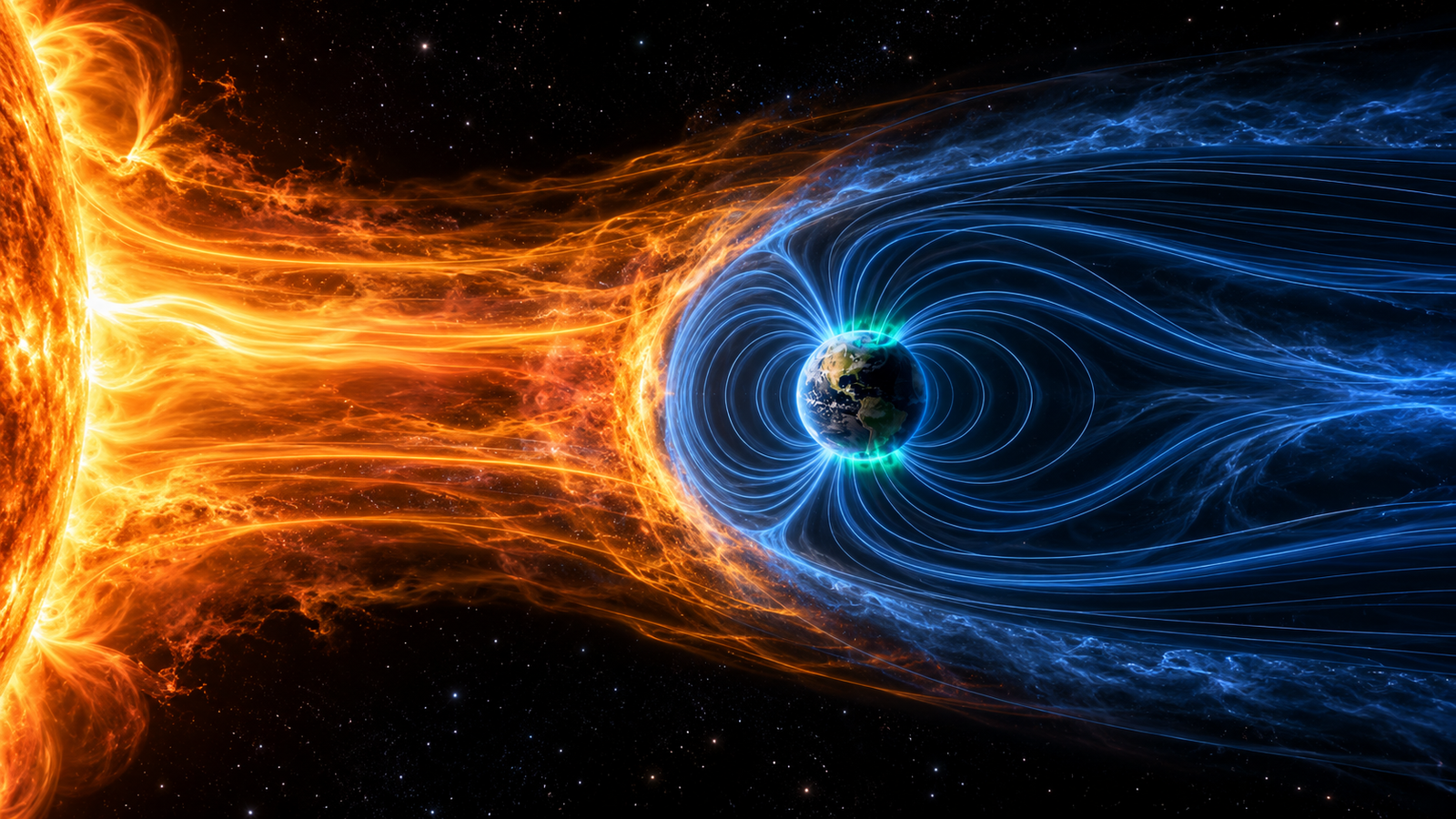
The direction of the interplanetary magnetic field is especially important. If the magnetic field carried by a CME points southward for an extended period, it can interact efficiently with Earth’s predominantly northward magnetic field.
This interaction can produce magnetic reconnection. In this process, magnetic field lines with different orientations reorganize, converting stored magnetic energy into particle motion, heat, and electrical currents. This allows energy from the solar wind to enter Earth’s magnetosphere and produce large-scale disturbances. [5]
When these disturbances become intense, they create a geomagnetic storm—a large-scale disruption of Earth’s magnetic environment that can last for hours or even several days.
Auroras: The Visible Expression of Space Weather
Auroras, known as the northern lights (aurora borealis) and southern lights (aurora australis), are among the most visible effects of space weather.
Charged particles from the solar wind and magnetosphere travel along Earth’s magnetic field lines toward the polar regions. There, they collide with oxygen and nitrogen atoms and molecules in the upper atmosphere, exciting them. When these particles return to lower-energy states, they emit light.
Green and red auroral colors are mainly associated with oxygen, while blue and purple colors are linked to nitrogen. During powerful geomagnetic storms, auroras can become visible at much lower latitudes than usual. [5]
An aurora is not a danger by itself, but it is a sign that energy transfer within Earth’s magnetosphere has intensified.
How Solar Storms Affect Technology
Satellites and Spacecraft
Space-based technologies are especially vulnerable because they operate directly within a changing radiation and plasma environment.
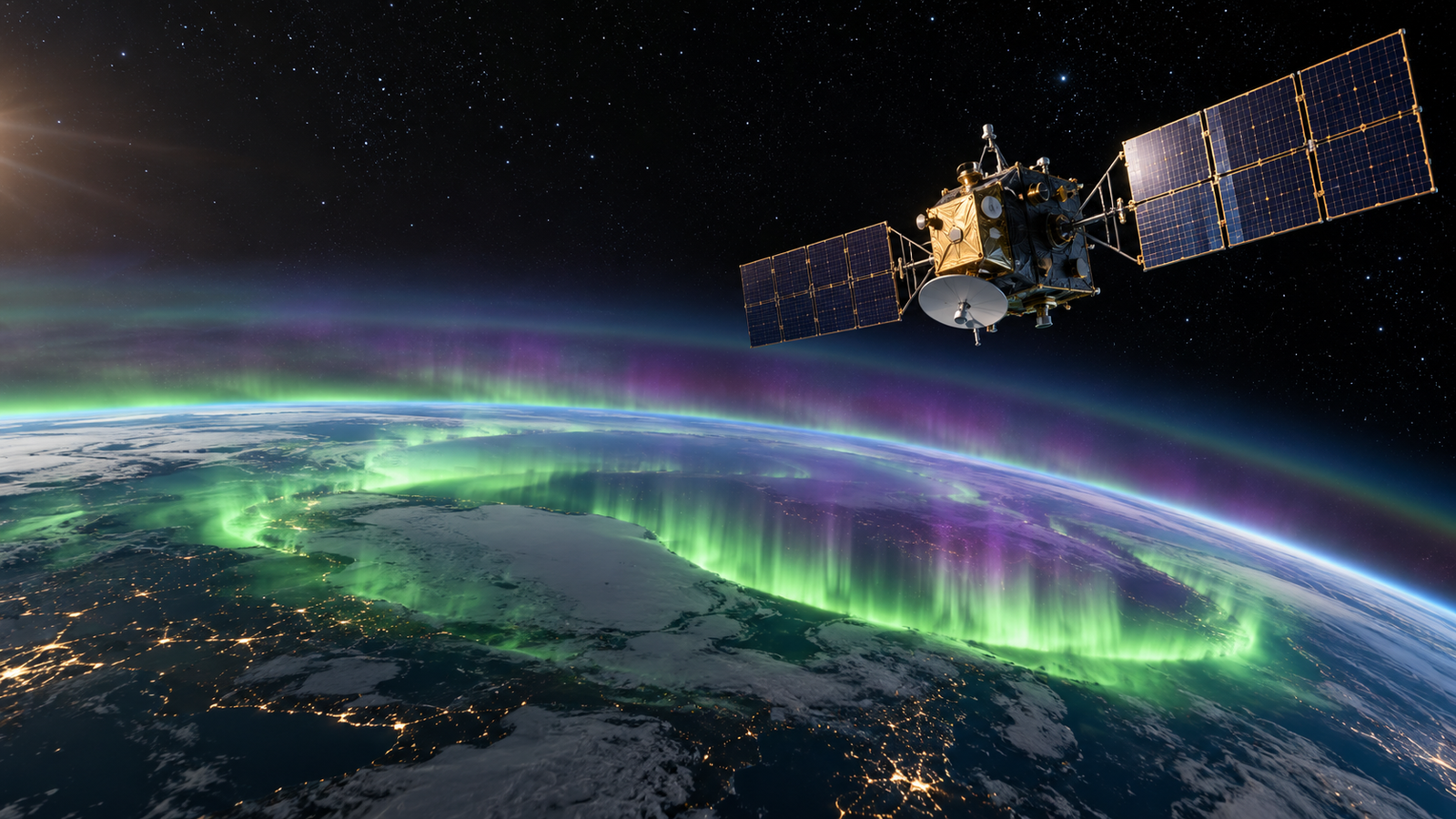
Solar storms can cause:
- Temporary errors in electronic components
- Memory disruptions
- Surface and internal electrical charging
- Gradual degradation of solar panels
- Orientation and communication problems
- Increased atmospheric drag in low Earth orbit
During geomagnetic storms, Earth’s upper atmosphere heats up and expands. As a result, satellites in low Earth orbit experience greater atmospheric drag. Their orbits can change, requiring operators to make additional calculations and corrections. [2]
GPS and Navigation
GPS and other global navigation systems rely on precise timing measurements from satellites. Their radio signals must travel through the ionosphere, an electrically charged layer of Earth’s upper atmosphere.
Geomagnetic storms can alter electron density in the ionosphere. These changes may cause signal delays, positioning errors, and temporary signal loss. This is especially important for aviation, maritime navigation, precision agriculture, surveying, and autonomous systems. [3]
Radio Communication and Aviation
High-frequency radio communication is particularly important on polar flight routes, where satellite coverage may be limited. Powerful solar flares and geomagnetic storms can disrupt the way radio waves travel through the ionosphere.
During such events, airlines may adjust polar flight routes. At high latitudes and altitudes, solar energetic particles can also increase radiation exposure for aircraft crews and passengers. This is not generally a danger to people on the ground, where Earth’s atmosphere provides effective protection. [2]
Power Grids and Geomagnetically Induced Currents
One of the most serious potential consequences of geomagnetic storms involves electrical power systems. When Earth’s magnetic field changes rapidly, Faraday’s law of induction allows electric fields and currents to develop in the ground and in long conducting systems.
These currents are called geomagnetically induced currents, or GICs. They can flow through high-voltage transmission lines, transformers, and pipelines.
GICs differ from the normal alternating current used by power grids. They introduce a nearly direct-current component into the system, potentially saturating transformer cores, causing excess heating, harmonic distortion, voltage instability, and incorrect operation of protective equipment. [6]
The level of risk depends not only on the strength of a solar storm, but also on the design of the power grid, geographic latitude, regional ground conductivity, and the preparedness of grid operators.
Historical Examples
The Carrington Event of 1859
In 1859, astronomer Richard Carrington observed an intense white-light solar flare. It was followed by one of the best-known geomagnetic storms in recorded history. Auroras appeared at unusually low latitudes, while telegraph systems experienced disruptions, sparks, and operational failures. [7]
The Carrington Event is often used as an example of extreme space weather. However, its exact physical strength is difficult to reconstruct because it occurred before modern satellite observations. Scientific literature treats it as an important historical reference, but not as a perfectly defined benchmark for all future extreme events. [8]
The 1989 Quebec Blackout
In March 1989, a geomagnetic storm generated geomagnetically induced currents in the Hydro-Québec power grid. Protective systems were triggered, and electricity was disrupted across Quebec for more than nine hours. [9]
This event demonstrated that space weather can affect not only satellites and communication systems, but also major urban infrastructure. It also encouraged the development of improved monitoring, forecasting, and protective systems for electrical grids.
The May 2024 G5 Geomagnetic Storm
In May 2024, Earth experienced a G5-level, or extreme, geomagnetic storm. It produced unusually widespread auroras and highlighted the dependence of modern infrastructure on space-weather monitoring. [10]
Although the event did not become a large-scale infrastructure disaster, it served as a real-world test for satellite operators, power-grid managers, aviation services, and navigation systems.
How Is Space-Weather Risk Measured?
NOAA’s Space Weather Prediction Center uses three main scales to communicate the severity of space-weather events:
- G Scale — Geomagnetic Storms: Ranges from G1 to G5. It measures disturbances in Earth’s magnetic field and their potential effects on satellites, navigation, power systems, and radio communication.
- S Scale — Solar Radiation Storms: Ranges from S1 to S5. It measures the intensity of high-energy solar particles and their possible radiation risks to astronauts, spacecraft, and high-altitude polar flights.
- R Scale — Radio Blackouts: Ranges from R1 to R5. It measures the impact of solar X-ray emissions on high-frequency radio communication, particularly on Earth’s sunlit side.
A G5 event is the highest level of geomagnetic storm. It can create widespread voltage-control problems, satellite-operation disruptions, degraded radio communication, and navigation errors. [11]
However, scales do not describe the entire situation. Two storms with the same rating can have different effects depending on the orientation of a CME’s magnetic field, the duration of the event, local geology, and the vulnerability of the affected technology.
Forecasting: Why Is It Still Difficult?
Space-weather forecasting continues to improve, but it is not yet as precise as ordinary weather forecasting.
Solar telescopes and spacecraft can observe sunspots, flares, and coronal mass ejections. When a CME is directed toward Earth, scientists can estimate its approximate arrival time from hours to several days in advance.
However, one of the most important factors—the direction of the magnetic field inside a CME—often cannot be measured accurately until the plasma cloud reaches monitoring spacecraft near the Sun–Earth L1 point. At that stage, operators may have only about 15 to 45 minutes of warning. [10]
This limitation explains why scientists may predict that a powerful storm is approaching, while still being unable to determine its precise local effects on a particular power grid, satellite, or GPS service.
Protection and Preparedness
Space weather cannot be completely prevented, but its consequences can be reduced significantly.
Satellite operators can:
- Place satellites into safe operating modes
- Delay sensitive maneuvers
- Monitor electrical charging and orbital changes
- Strengthen monitoring of communication and hardware systems
Power-grid operators can:
- Monitor GICs and geomagnetic data
- Reduce system loading when necessary
- Adjust protective thresholds
- Use contingency procedures during severe storms
Aviation services can reroute polar flights, use alternative communication methods, and assess changes in the radiation environment. In every case, timely scientific warnings are essential.
Conclusion
Space weather reminds us that Earth is not an isolated world. Solar magnetic activity can affect our planet’s magnetosphere, ionosphere, and technological infrastructure within minutes, hours, or days.
Auroras are the beautiful visible expression of this interaction. Behind them, however, are complex plasma and magnetic processes that can disrupt communications, navigation, satellites, and electrical power systems.
The study of solar storms is important not only for technological safety on Earth, but also for future human missions to the Moon, Mars, and beyond. As humanity becomes more dependent on electronic and space-based systems, understanding and forecasting the changing behavior of our star becomes increasingly important.
Sources
[1] ESA — Space Weather and Its Hazards
[2] NASA — Solar Storms and Flares
[3] NASA Solar Dynamics Observatory — Space Weather
[4] NASA — Earth’s Magnetosphere
[5] NASA — Auroras and Magnetic Reconnection
[6] NOAA SWPC — Solar Physics and Terrestrial Effects
[7] NOAA — Space Weather: Storms from the Sun
[8] Hudson (2021) — Carrington Events
[9] Hydro-Québec — The March 1989 Blackout
[10] NOAA SWPC — Space Weather 101 Factsheet
[11] NOAA Space Weather Scales