
Gravitational Waves: How We “Listen” to the Universe
Gravitational waves reveal cosmic events invisible to light.
Share this story
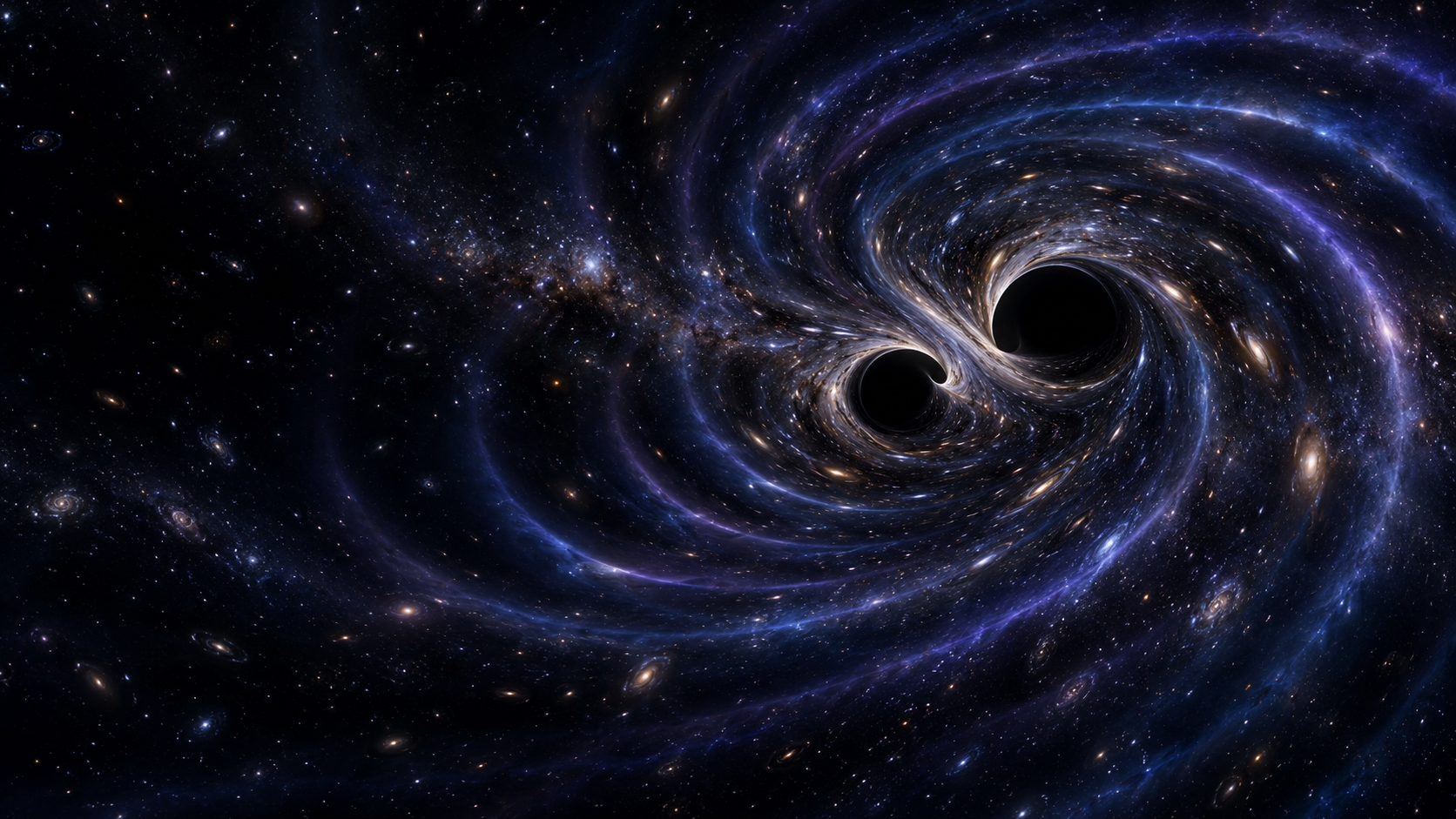
Discover what gravitational waves are, how LIGO, Virgo, and KAGRA detect tiny distortions in spacetime, and what these signals reveal about black holes, neutron stars, and the early Universe.
Many of the most powerful events in the Universe are nearly invisible to conventional telescopes. The merger of two black holes may produce little or no detectable light, yet it can disturb the very fabric of space and time, creating gravitational waves.
Gravitational-wave astronomy allows scientists to study phenomena that were once accessible only through theoretical models. This field does not replace light-based astronomy; instead, it complements it by opening a fundamentally new observational window onto the Universe.
Gravitational waves are not sound waves and do not travel through air or any material medium. They are extremely faint, but real, distortions of spacetime.
What Are Gravitational Waves?
According to Einstein’s general theory of relativity, mass and energy curve spacetime, and this curvature is experienced as gravity. When extremely massive objects move rapidly in an asymmetric way, changes in the gravitational field can propagate outward at the speed of light in the form of gravitational waves. [1][2]
As a gravitational wave passes through space, it alternately stretches and compresses distances in perpendicular directions. This effect is measured through a quantity called strain:
h = ΔL / L
Here, ΔL is the change in distance, while L is the original distance. For gravitational waves reaching Earth, h is typically around 10⁻²¹ or even smaller. This means that the change measured across one of LIGO’s 4-kilometre arms can be only a few 10⁻¹⁸ metres—far smaller than the size of a proton.
In general relativity, gravitational waves have two main polarizations, conventionally represented by the “+” and “×” patterns. These polarizations affect the relative positions of objects differently and allow gravitational-wave detectors to measure the properties of a passing wave.
What Events Produce Gravitational Waves?
Large mass alone is not enough to produce gravitational waves. The mass must move rapidly in a non-symmetrical way. In physics, this is described by a changing quadrupole moment.
A perfectly spherical collapse produces almost no gravitational waves because it preserves symmetry. In contrast, two massive objects orbiting each other constantly change the quadrupole structure of the system and emit gravitational radiation.
The main sources include:
- Mergers of two stellar-mass black holes
- Mergers of two neutron stars
- Black hole–neutron star mergers
- Rapidly rotating neutron stars with imperfect symmetry
- Asymmetric core-collapse supernovae
- Supermassive black hole binaries
- Possible stochastic or background gravitational waves from the early Universe
In compact binary systems, gravitational waves carry away energy and angular momentum. As a result, the orbit gradually shrinks, the orbital frequency increases, and the two objects eventually merge.
From Theoretical Prediction to Direct Detection
Albert Einstein predicted the existence of gravitational waves in 1916. However, the precision required to detect them remained technologically impossible for decades.
The first highly convincing indirect evidence came in 1974, when Russell Hulse and Joseph Taylor discovered the binary pulsar system PSR B1913+16. The gradual orbital decay of this system closely matched the energy loss predicted by general relativity through gravitational radiation. Their work was recognized with the 1993 Nobel Prize in Physics. [3]
The first direct detection occurred on 14 September 2015, when the two LIGO detectors in the United States recorded the signal GW150914. It originated from the merger of two black holes with masses of approximately 36 and 29 times that of the Sun. The merger produced a final black hole with a mass of about 62 solar masses, while energy equivalent to roughly three solar masses was emitted as gravitational waves. [4]
The signal came from a distance of approximately 410 megaparsecs, and the maximum strain measured on Earth was around 10⁻²¹. GW150914 not only confirmed the existence of gravitational waves, but also provided the first direct evidence that two black holes can merge.
How Do Gravitational-Wave Detectors Work?
LIGO, Virgo, and KAGRA are laser interferometers. Their purpose is not to capture light from distant celestial objects, but to measure extremely small changes in spacetime itself.
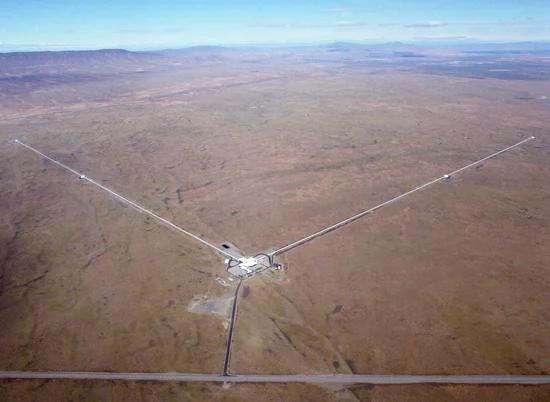
Each LIGO detector has two perpendicular arms, each 4 kilometres long. A laser beam is split into two parts, travels along the arms, reflects many times between mirrors, and returns to a measurement point. If both arms have the same length, the returning laser beams recombine in a predictable way. When a gravitational wave passes through the detector, one direction is slightly stretched while the other is compressed, changing the interference pattern of the laser light. [8]
Detector performance is affected by many sources of noise, including:
- Seismic vibrations
- Human-made and environmental disturbances
- Thermal motion in mirrors and components
- Laser and quantum measurement limitations
- Electronic noise
For this reason, gravitational-wave detectors operate in extreme vacuum conditions and use multilayer seismic isolation, highly stable lasers, and quantum technologies such as squeezed light to reduce measurement noise.
A signal from a single detector is not enough to confirm a discovery reliably. The two LIGO observatories in the United States, the Virgo detector in Europe, and the KAGRA detector in Japan work together to verify the astrophysical nature of a signal and to constrain the source’s position in the sky through differences in arrival time.
The “Chirp”: The Physical Story of a Merger
The gravitational-wave signal produced by a compact binary merger is often called a “chirp” because both its frequency and amplitude increase over time.
It generally consists of three main stages.
Inspiral
The two objects slowly move closer together as they lose energy through gravitational-wave emission. The wave frequency gradually rises.
Merger
During the final orbits, the speed and dynamics of the system become extreme. This is the strongest phase of the gravitational-wave signal.
Ringdown
After the merger, the newly formed black hole briefly oscillates before settling into a stable state. This phase is called ringdown. It contains information about the final black hole’s mass, spin, and the behaviour of gravity in an extremely strong gravitational field.
By analysing the detailed waveform, astronomers can estimate the masses, spins, distance, orbital inclination, and, in some cases, information about the internal structure of neutron stars.
GW170817: A Turning Point for Multi-Messenger Astronomy
On 17 August 2017, the LIGO and Virgo detectors recorded GW170817, a gravitational-wave signal from the merger of two neutron stars. Approximately 1.7 seconds later, space-based gamma-ray observatories detected a short gamma-ray burst, GRB 170817A. [5]
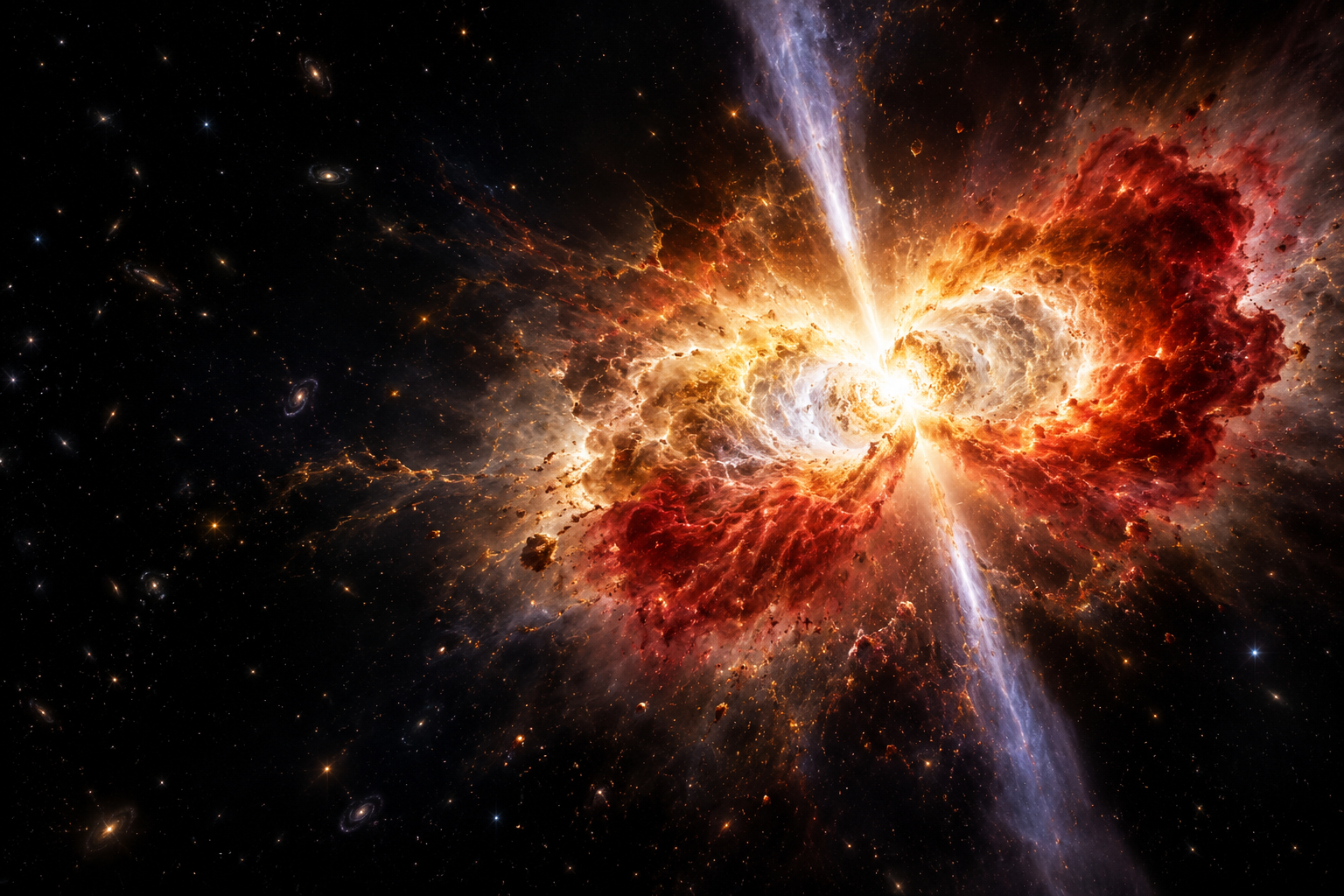
Follow-up observations in visible light, infrared, X-rays, and radio waves identified the electromagnetic counterpart of the explosion: a kilonova. This was the first cosmic event observed through both gravitational waves and light.
GW170817 was significant for several reasons:
- It confirmed the connection between neutron star mergers and short gamma-ray bursts.
- It revealed a kilonova whose emission was consistent with the production of heavy elements through rapid neutron capture, or the r-process.
- It provided evidence that neutron star mergers are an important source of heavy r-process elements.
- It enabled astronomers to identify the host galaxy, NGC 4993.
- It demonstrated that gravitational waves can be used to measure the expansion of the Universe.
The kilonova data support the production of heavy elements, including lanthanides. However, scientific accuracy requires an important distinction: a single event cannot determine the complete cosmic origin of every individual element, such as gold. [6]
Gravitational Waves as “Standard Sirens”
In traditional astronomy, distances are often measured using “standard candles,” such as Type Ia supernovae. In gravitational-wave astronomy, a similar method is called a standard siren.
The waveform of a merging system can be used to estimate the luminosity distance to the source directly, without relying on the conventional cosmic distance ladder. If electromagnetic observations identify the host galaxy and measure its redshift, astronomers can obtain an independent estimate of the Hubble constant. [7]
GW170817 provided the first such measurement of the Hubble constant. At the time, the uncertainty remained large, so a single event could not resolve the tension between different measurements of the Hubble constant. However, combining many future standard-siren observations may provide a powerful independent method for studying the expansion history of the Universe.
The Full Gravitational-Wave Spectrum
Different sources produce gravitational waves at different frequencies. As a result, different types of detectors are needed to observe the complete gravitational-wave spectrum.
Ground-Based Interferometers
LIGO, Virgo, and KAGRA are sensitive to frequencies from several tens of hertz to several kilohertz. They are particularly suited to detecting mergers involving stellar-mass black holes and neutron stars.
The GWTC-4.0 catalogue, released in 2025 and based on the first part of the fourth observing run, added 128 new candidate signals from compact binary mergers. [9]
Pulsar Timing Arrays
Pulsars emit extremely regular radio pulses and can function as natural cosmic clocks. If a low-frequency gravitational-wave background passes through Earth, it slightly alters the arrival times of radio pulses from different pulsars.
In 2023, the NANOGrav collaboration presented evidence for a gravitational-wave background using observations of 68 pulsars collected over 15 years. The observed correlation pattern is consistent with the combined contribution of many supermassive black hole binaries. However, the precise astrophysical or possible cosmological origin of this background remains an active area of research. [10]
Space-Based Interferometers
The ESA-led LISA mission is planned for launch in 2035. It will consist of three spacecraft orbiting the Sun in a triangular formation, separated by approximately 2.5 million kilometres. [11]
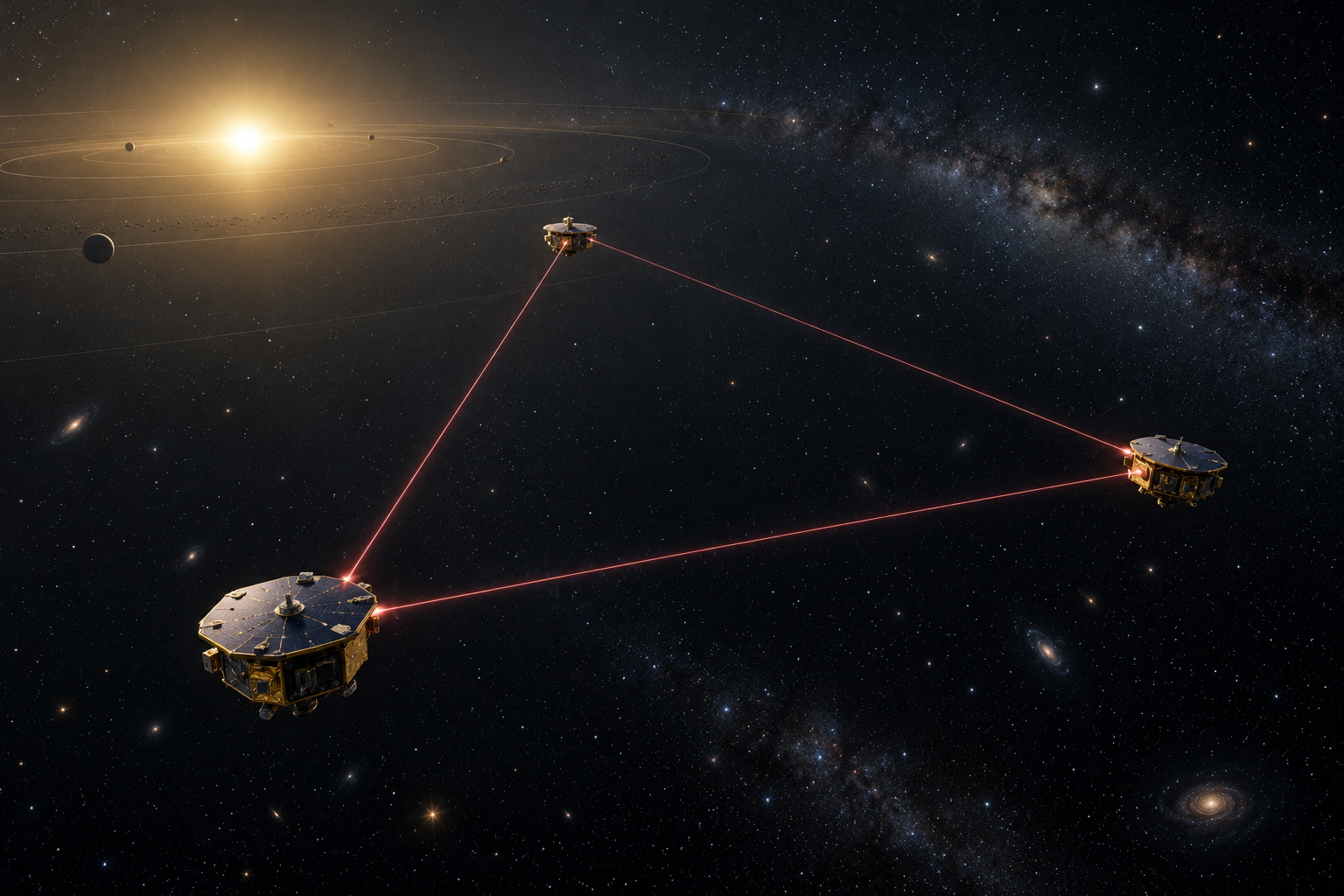
LISA will operate in the millihertz frequency range and is expected to study:
- Mergers of supermassive black holes
- Extreme mass-ratio inspirals, in which a smaller black hole or compact star orbits a supermassive black hole
- Binary white dwarf systems
- Possible stochastic cosmological backgrounds
Possible Signals from the Early Universe
Theoretical models suggest that cosmic inflation, phase transitions in the early Universe, or cosmic strings may have produced a gravitational-wave background. The search for such primordial waves also continues through studies of the polarization of the cosmic microwave background.
At present, there has been no reliable direct detection of primordial gravitational waves. [12]
What Do Gravitational Waves Teach Us About Physics?
Gravitational-wave astronomy is important not only because it reveals new cosmic events, but also because it tests the fundamental laws of physics under extreme conditions.
Black Hole Populations
Large samples of mergers help scientists understand how black hole binaries form, what masses and spins they possess, and whether some black holes may be remnants of previous mergers.
Matter Inside Neutron Stars
During neutron star mergers, tidal effects slightly alter the phase of the gravitational-wave signal. These changes are connected to the equation of state of ultra-dense matter and can help constrain neutron star radii, densities, and possible forms of exotic matter inside them.
Tests of General Relativity
Combining the inspiral, merger, and ringdown phases makes it possible to test general relativity in strong gravitational fields. In the case of GW170817, the nearly simultaneous arrival of gravitational and gamma-ray signals placed strong constraints on theories in which gravity propagates at a speed significantly different from the speed of light. [5]
Cosmology
Standard sirens can measure the expansion rate of the Universe, while pulsar timing arrays and the future LISA mission may reveal the merger history of supermassive black holes and galaxies.
Important Limitations and Common Misconceptions
It is important to distinguish established scientific results from simplified public descriptions of gravitational waves.
- Detectors do not literally “hear” gravitational waves. Public audio recordings are sonifications that convert data into audible frequencies.
- A gravitational-wave signal is not an image. It is a time-dependent data series that is compared with theoretical models.
- The source location can remain uncertain, especially when only a small number of detectors register the event.
- Distance and orbital inclination can have related uncertainties.
- Not all theoretical sources are currently detectable with existing instruments.
- Evidence for a stochastic background does not mean that each individual source has already been identified.
Conclusion
Gravitational waves have enabled humanity to study the Universe not only through light, but also through the motion of spacetime itself. Mergers of black holes and neutron stars are now observable astronomical events rather than purely theoretical predictions.
This new branch of astronomy is helping scientists understand the origin of black holes, the internal structure of neutron stars, the production of heavy elements, the merger history of galaxies, and the expansion of the Universe. The continued development of the LIGO–Virgo–KAGRA network, pulsar timing programs, and the future LISA mission will make gravitational waves one of the most important observational tools in twenty-first-century astrophysics.
Scientific Sources and Books
[1] Maggiore, M. — Gravitational Waves, Volume 1: Theory and Experiments
Oxford University Press
[2] Sathyaprakash, B. S. & Schutz, B. F. — Physics, Astrophysics and Cosmology with Gravitational Waves
Living Reviews in Relativity, 2009
[3] Nobel Prize — The 1993 Nobel Prize in Physics: Hulse and Taylor
NobelPrize.org
[4] Abbott et al. — Observation of Gravitational Waves from a Binary Black Hole Merger
Physical Review Letters, 2016
[5] Abbott et al. — GW170817: Observation of Gravitational Waves from a Binary Neutron Star Inspiral
Physical Review Letters, 2017
[6] Kasen et al. — Origin of the Heavy Elements in Binary Neutron-Star Mergers from a Gravitational-Wave Event
Nature, 2017
[7] LIGO Scientific Collaboration and Virgo Collaboration — A Gravitational-Wave Standard Siren Measurement of the Hubble Constant
Nature, 2017
[8] LIGO Laboratory — How LIGO Works
LIGO Today
[9] LIGO–Virgo–KAGRA Collaboration — GWTC-4.0: Catalog Update from the O4a Observing Run
LIGO Scientific Collaboration
[10] Agazie et al. — The NANOGrav 15-Year Data Set: Evidence for a Gravitational-Wave Background
The Astrophysical Journal Letters, 2023
[11] European Space Agency — LISA: Laser Interferometer Space Antenna
ESA
[12] Maggiore, M. — Gravitational Waves, Volume 2: Astrophysics and Cosmology
Oxford University Press
[13] Creighton, J. D. E. & Anderson, W. G. — Gravitational-Wave Physics and Astronomy: An Introduction to Theory, Experiment and Data Analysis
Wiley, 2011