
Animal Migration: How Birds, Mammals, and Insects Navigate Across the Planet
Animal migration relies on biological clocks, inherited programmes, learned routes, and sensory cues such as sunlight, stars, and Earth’s magnetic field.
Share this story

Animal migration is a recurring, directional movement between distinct regions, usually synchronized with seasonal changes in food availability, reproduction, climate, or survival conditions. It is not simply wandering or dispersal: migration involves an evolved biological programme, precise timing, orientation, navigation, and the capacity to overcome substantial ecological obstacles. [1]
From Arctic terns crossing oceans to monarch butterflies travelling across North America, and from humpback whales moving between feeding and breeding grounds to ungulates crossing seasonal grasslands, migration connects ecosystems across continents and oceans. These movements are among the most complex phenomena in animal ecology.
Migration as Part of the Annual Cycle
Migration should be understood as one stage of an animal’s annual cycle. Breeding, moulting, feeding, hibernation, reproduction, and migration are physiologically interconnected. An individual cannot optimize one stage independently without affecting the others.
For many migratory birds, spring migration must coincide with the arrival of suitable breeding conditions, including food availability, nesting habitat, and favourable temperatures. Autumn migration, by contrast, often begins before local conditions become entirely unsuitable. This timing reduces competition and allows animals to reach wintering areas before resources become limited. [2]
The timing of migration is therefore not determined by one environmental signal alone. It results from the interaction of inherited biological rhythms, day length, weather, food conditions, hormonal changes, and previous experience.
Why Migration Evolved
Migration evolves when moving between regions produces a greater survival or reproductive advantage than remaining in one location throughout the year. Seasonal environments often provide high food availability during part of the year but become unsuitable during another period because of low temperatures, drought, snow cover, flooding, or declining productivity.
Temperate and polar regions can provide extremely productive breeding conditions during spring and summer. Long daylight periods support abundant insects, plant growth, and marine productivity. However, winter conditions may become energetically costly or make food inaccessible. Migration allows animals to exploit seasonal peaks in productivity while avoiding the most severe conditions. [1]
Migration also carries substantial costs. Long-distance movement requires energy, exposes animals to predators and storms, and increases the risk of exhaustion, disease, habitat loss, and navigational error. Consequently, migration persists only where its benefits outweigh these risks.
Orientation and Navigation: Related but Different Abilities
Orientation and navigation are often treated as identical processes, but they refer to different biological abilities.
Orientation is the capacity to maintain a particular direction. An animal may orient southward during autumn or northward during spring using the Sun, stars, wind patterns, coastlines, or Earth’s magnetic field.
Navigation is more complex. It involves determining the animal’s position relative to a destination and adjusting movement accordingly. True navigation allows an animal to return to a breeding site, wintering area, or stopover habitat even after displacement from its normal route. [3]
Many migratory species combine several orientation systems. The use of multiple cues provides resilience: when clouds obscure the Sun or stars, animals may rely more heavily on magnetic information, landscape features, odours, wind conditions, or learned routes.
The Sun, Stars, and Internal Biological Clocks
The Sun is one of the most important orientation cues for many diurnal migrants. Its position changes across the sky during the day, so animals must compensate for time. This requires an internal circadian clock that allows the animal to interpret the Sun’s position correctly.
For example, a bird flying south in the morning cannot use the same solar direction in the afternoon because the Sun has moved. Its internal clock enables it to convert the Sun’s position into a reliable compass direction. Experiments have shown that altering the internal clocks of birds can shift their preferred migratory direction, demonstrating the close relationship between biological timing and solar orientation. [3]
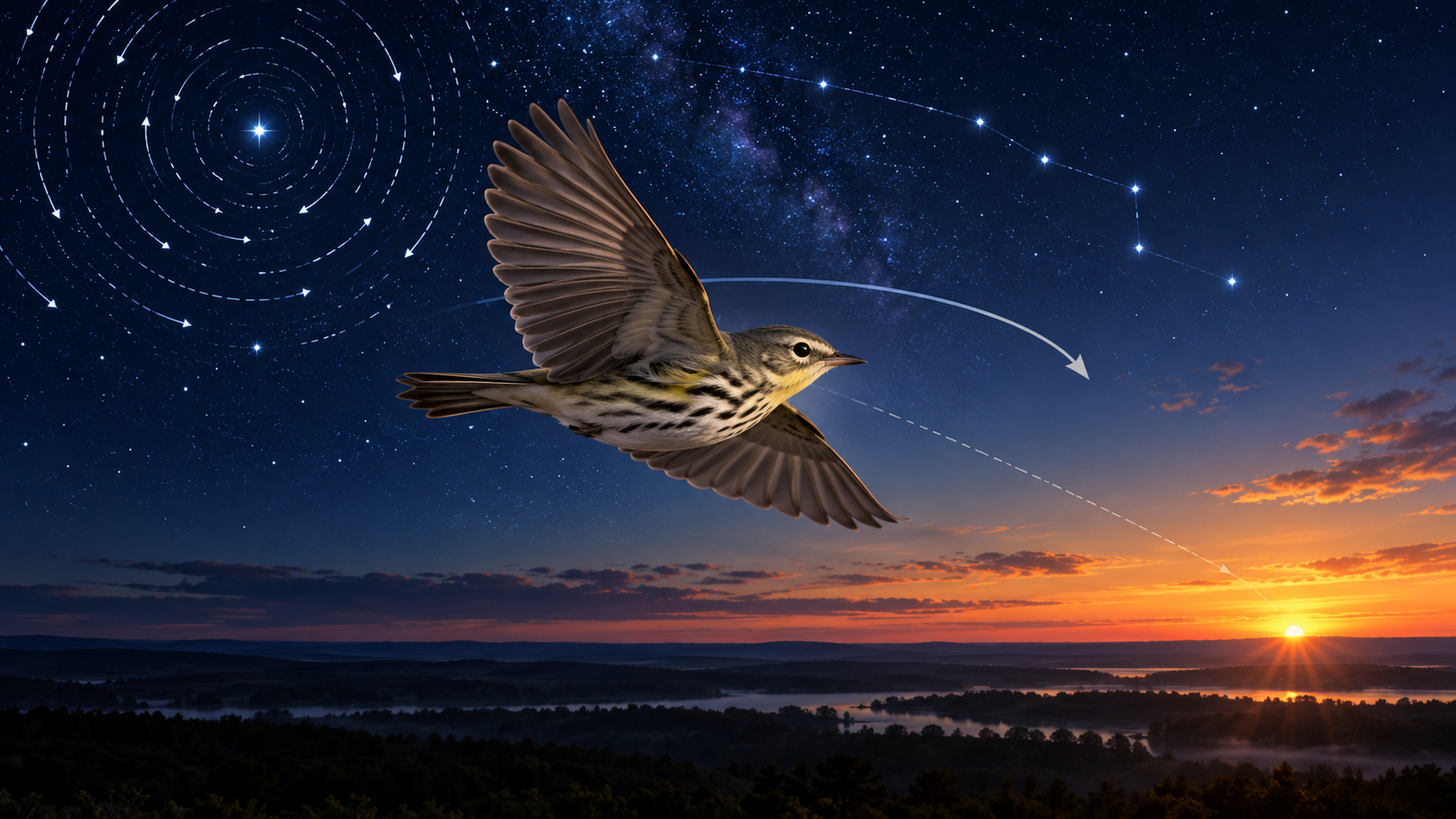
Nocturnal migratory birds may use stars as orientation references. They do not memorize every constellation individually; instead, many species appear to use the apparent rotation of the night sky around the celestial pole. This provides a stable directional framework during clear nights.
Polarized light near sunrise and sunset may also help calibrate solar compasses. Even when the Sun is below the horizon, patterns of polarized light in the atmosphere can contain directional information.
Earth’s Magnetic Field and Magnetoreception
Earth’s magnetic field provides another major source of navigational information. The field has directional properties, including polarity, inclination, and intensity. These properties vary geographically, meaning that animals may use magnetic information both as a compass and, in some cases, as part of a positional map. [4]

Magnetoreception has been studied in birds, sea turtles, fish, insects, and mammals. The mechanisms differ among groups and remain an active area of research.
One major hypothesis proposes that light-sensitive molecules known as cryptochromes, located in the eyes of some birds, may participate in a magnetic compass system. This mechanism is thought to involve quantum chemical reactions that are influenced by magnetic fields. [5]
A second mechanism may involve magnetite, an iron-containing mineral capable of responding to magnetic forces. Evidence suggests that magnetite-based systems may contribute to magnetic perception in some animals, particularly when detecting changes in field intensity or local magnetic conditions. [6]
Magnetic information is especially important when visual cues are limited. Birds flying through clouds, sea turtles crossing open oceans, and insects moving across unfamiliar landscapes may continue to maintain direction even without visible landmarks.
Inherited Programmes, Experience, and Social Learning
Migration is shaped by both genetics and learning. In some species, particularly small songbirds, young individuals undertake their first migration without travelling alongside experienced adults. Their initial route is guided largely by inherited migratory instructions, including direction, timing, duration, and in some cases altitude. [7]
This inherited programme is not always a detailed map. A young bird may have a genetically encoded tendency to fly in a particular direction for a certain period, while later experience improves route precision and destination recognition.
Other animals rely heavily on social learning. Young cranes, geese, whales, elephants, and some ungulates may learn migration routes from parents or older group members. The loss of experienced individuals can therefore disrupt migration traditions that may have been maintained across generations.
Migration is often best understood as a combination of inherited predisposition and environmental learning. Genes provide an initial framework; experience refines the route.
Birds, Mammals, and Insects: Different Solutions to the Same Problem
Birds are among the most intensively studied migratory animals because many species travel between continents on predictable annual schedules. Their navigation systems can integrate celestial cues, magnetic information, wind conditions, topography, olfactory signals, and learned landmarks.
Marine mammals face a different challenge. Whales often migrate across open oceans where visual landmarks are limited. Their movements may be influenced by ocean currents, water temperature, sound, geomagnetic information, prey distribution, and inherited or socially transmitted routes. [8]
Terrestrial mammals, including caribou, wildebeest, zebras, and elephants, frequently migrate in response to seasonal rainfall, vegetation growth, snow cover, and water availability. Their routes may extend across national borders and depend on the continued availability of movement corridors. [8]
Insects also perform remarkable migrations despite their small size and short lifespan. Monarch butterflies, for example, complete a multigenerational migration cycle. Individuals travelling south in autumn may reach overwintering areas they have never previously visited, while later generations return northward during spring and summer. Their movements depend on solar orientation, circadian rhythms, wind conditions, and inherited migratory behaviour. [5]
How Scientists Track Migration
Modern technology has transformed the study of migration. Ringing and banding programmes remain valuable, but they have been supplemented by GPS tags, satellite transmitters, geolocators, accelerometers, radar systems, acoustic monitoring, stable-isotope analysis, genetic methods, and automated radio-tracking networks. [9]
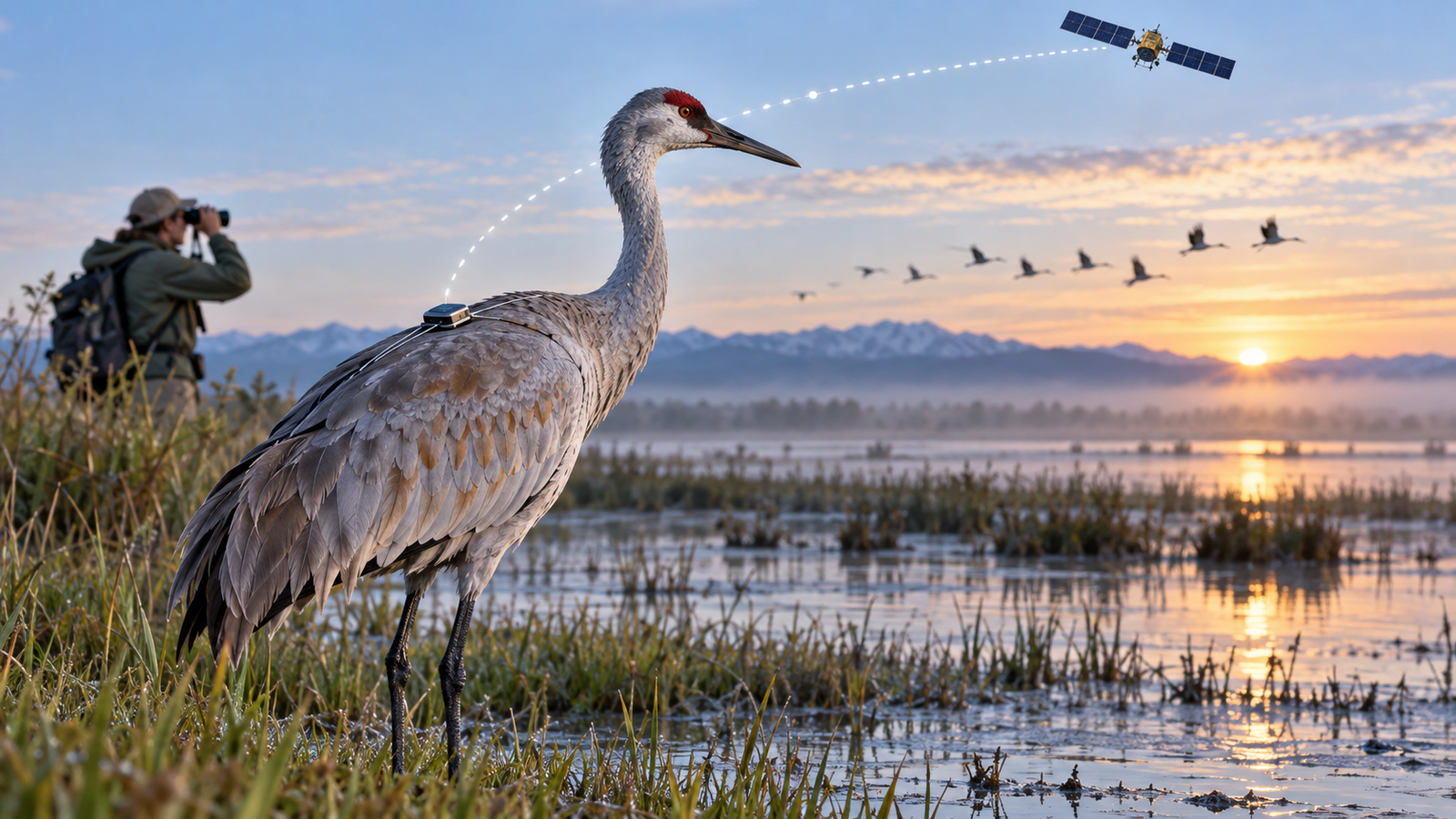
GPS tracking can reveal fine-scale movement, including stopover locations, migration speed, altitude, route selection, and habitat use. Satellite telemetry is particularly useful for large birds, marine mammals, sea turtles, and wide-ranging terrestrial mammals.
Geolocators are small light-level devices that estimate geographic position from sunrise and sunset times. They are light enough to be carried by smaller birds, although they usually require the animal to be recaptured to retrieve the data.
Weather radar can detect the mass movement of birds and insects through the atmosphere. This allows researchers to study migration at continental scales and identify how wind, storms, temperature, and artificial light affect migratory behaviour. [10]
Migratory Connectivity: A Central Conservation Concept
Migratory connectivity describes the relationship between breeding populations, stopover sites, migration routes, and wintering areas. A species may appear secure in one region while facing severe threats elsewhere along its annual route.
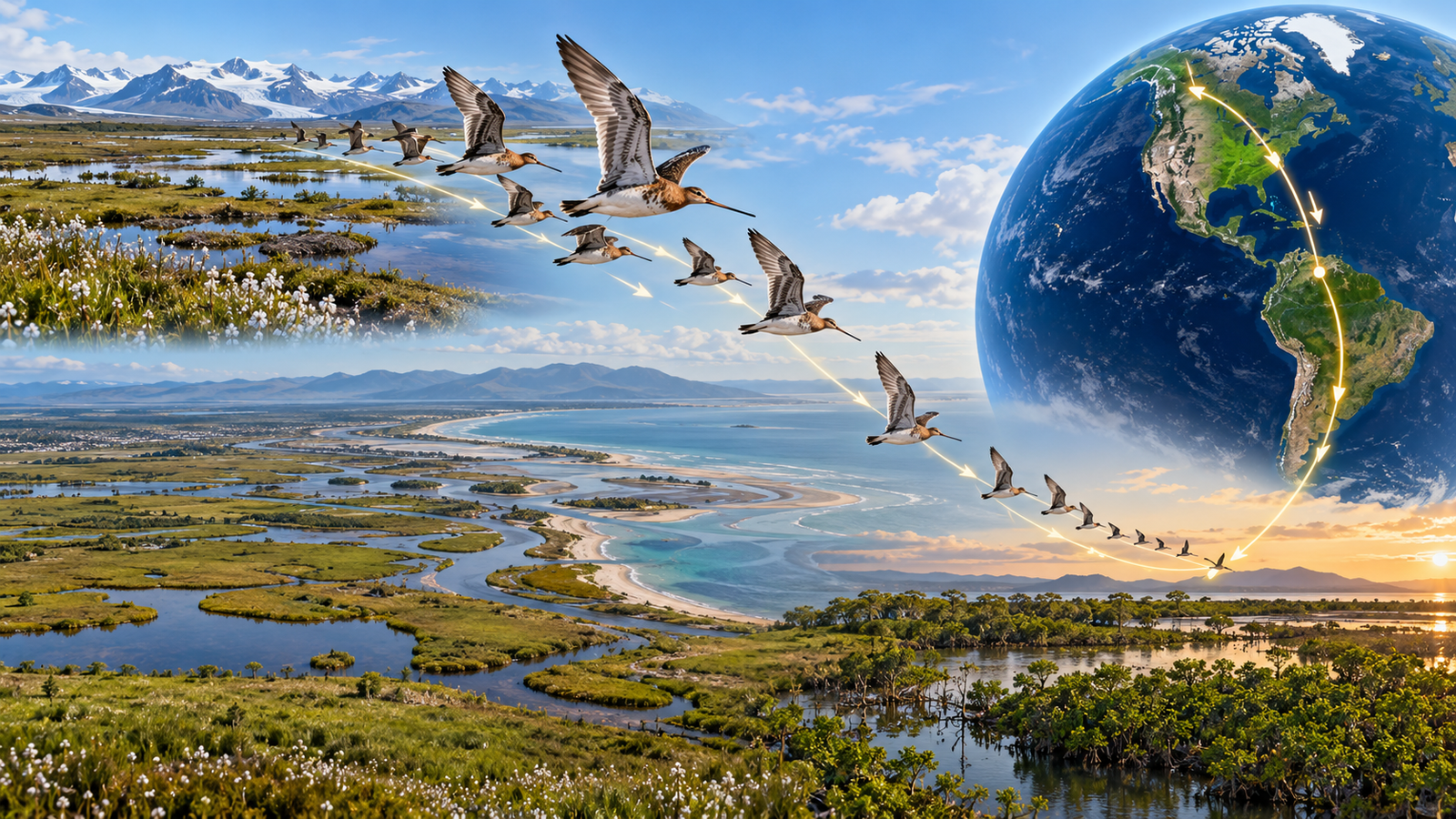
For example, a bird population breeding successfully in northern Europe may decline because wetlands in Africa are degraded, because food resources disappear at a Mediterranean stopover site, or because collision risks increase along a migration corridor. Conservation therefore cannot focus only on breeding grounds. [11]
The most effective conservation strategies protect the entire migratory system: breeding habitats, feeding areas, stopover sites, migration corridors, and wintering regions. International cooperation is essential because many species cross numerous political borders during a single annual cycle.
Major Threats to Migratory Species
Migratory animals face threats at every stage of their journey. Habitat destruction is among the most serious. Wetlands, coastal habitats, grasslands, forests, estuaries, and river corridors are often converted, fragmented, polluted, or altered before migrants arrive.
Artificial light at night can disorient nocturnally migrating birds and insects. Glass buildings, power lines, wind turbines, and other infrastructure may create collision risks, especially in major migration corridors.
Climate change affects migration by shifting temperatures, precipitation patterns, sea ice, plant growth, insect emergence, and ocean productivity. A migrant may arrive at its breeding site at the historical time but encounter a mismatch between its arrival and peak food availability. Such phenological mismatches can reduce reproductive success. [2]
According to the Convention on Migratory Species’ 2026 interim assessment, 49% of assessed CMS-listed migratory species show declining population trends, while 24% are globally threatened. These figures apply specifically to the assessed CMS-listed species and should not be interpreted as representing all migratory animals. [12]
Protecting migratory species requires coordinated habitat conservation, reduction of avoidable mortality, restoration of ecological corridors, light-pollution management, climate adaptation, and long-term international monitoring. [13]
Conclusion
Animal migration is not a single behaviour but a highly integrated biological system. It depends on internal clocks, inherited programmes, sensory perception, learning, environmental conditions, and the integrity of habitats distributed across vast geographic areas.
Birds, mammals, fish, reptiles, and insects have evolved different solutions to the same challenge: travelling through changing environments while finding food, avoiding danger, reproducing successfully, and returning to the places required for survival.
Understanding migration is therefore essential not only for animal behaviour research, but also for conservation. A migratory species can survive only if the ecological chain connecting its breeding areas, stopover habitats, migration corridors, and wintering grounds remains intact.
Sources
- Dingle, H. Migration: The Biology of Life on the Move. Oxford University Press, 2014.
https://doi.org/10.1093/acprof:oso/9780199640386.001.0001 - Fudickar, A. M., et al. “Annual Cycle Plasticity Across Seasons and Environments.” Annual Review of Ecology, Evolution, and Systematics, 2021.
https://doi.org/10.1146/annurev-ecolsys-012021-031035 - Mouritsen, H. “Long-Distance Navigation and Magnetoreception in Migratory Animals.” Nature, 2018.
https://doi.org/10.1038/s41586-018-0176-1 - Wiltschko, R., and Wiltschko, W. “Magnetoreception in Birds.” The European Physical Journal Special Topics, 2023.
https://doi.org/10.1140/epjs/s11734-022-00610-w - Reppert, S. M., Gegear, R. J., and Merlin, C. “Cryptochrome-Mediated Light-Dependent Magnetosensitivity in the Monarch Butterfly.” Nature Communications, 2014.
https://doi.org/10.1038/ncomms5164 - Ritz, T., et al. “Resonance Effects Indicate a Radical-Pair Mechanism for Avian Magnetic Compass.” Nature, 2004.
https://doi.org/10.1038/nature02534 - Merlin, C., and Liedvogel, M. “The Genetics and Epigenetics of Migratory Behaviour.” Journal of Experimental Biology, 2019.
https://doi.org/10.1242/jeb.191890 - Gu, Z., et al. “Animal Migration in a Changing World.” Annual Review of Animal Biosciences, 2024.
https://doi.org/10.1146/annurev-animal-021122-092239 - Caballero-López, B. “Tracking Animal Migration: Methods, Challenges, and Opportunities.” Journal of Avian Biology, 2024.
https://doi.org/10.1111/jav.03238 - Deakin, Z., et al. “Tracking Animal Movement with Automated Radio Telemetry.” Movement Ecology, 2023.
https://doi.org/10.1186/s40462-023-00388-z - Cooke, S. J., et al. “Migratory Connectivity and the Conservation of Mobile Species.” Biological Reviews, 2024.
https://doi.org/10.1111/brv.13066 - Convention on the Conservation of Migratory Species of Wild Animals. State of the World’s Migratory Species: Interim Report, 2026.
https://www.cms.int/sites/default/files/publication/swms_interim-report_2026_e_0.pdf - Iwamura, T., et al. “Conservation Challenges for Migratory Species in a Changing World.” Ecological Applications, 2019.
https://doi.org/10.1002/eap.1960