
Geological Time: Earth’s Time Scale and the Scientific Record of Deep History
Explore Earth’s 4.54-billion-year history through eons, eras, periods, fossils, and radiometric dating.
Share this story
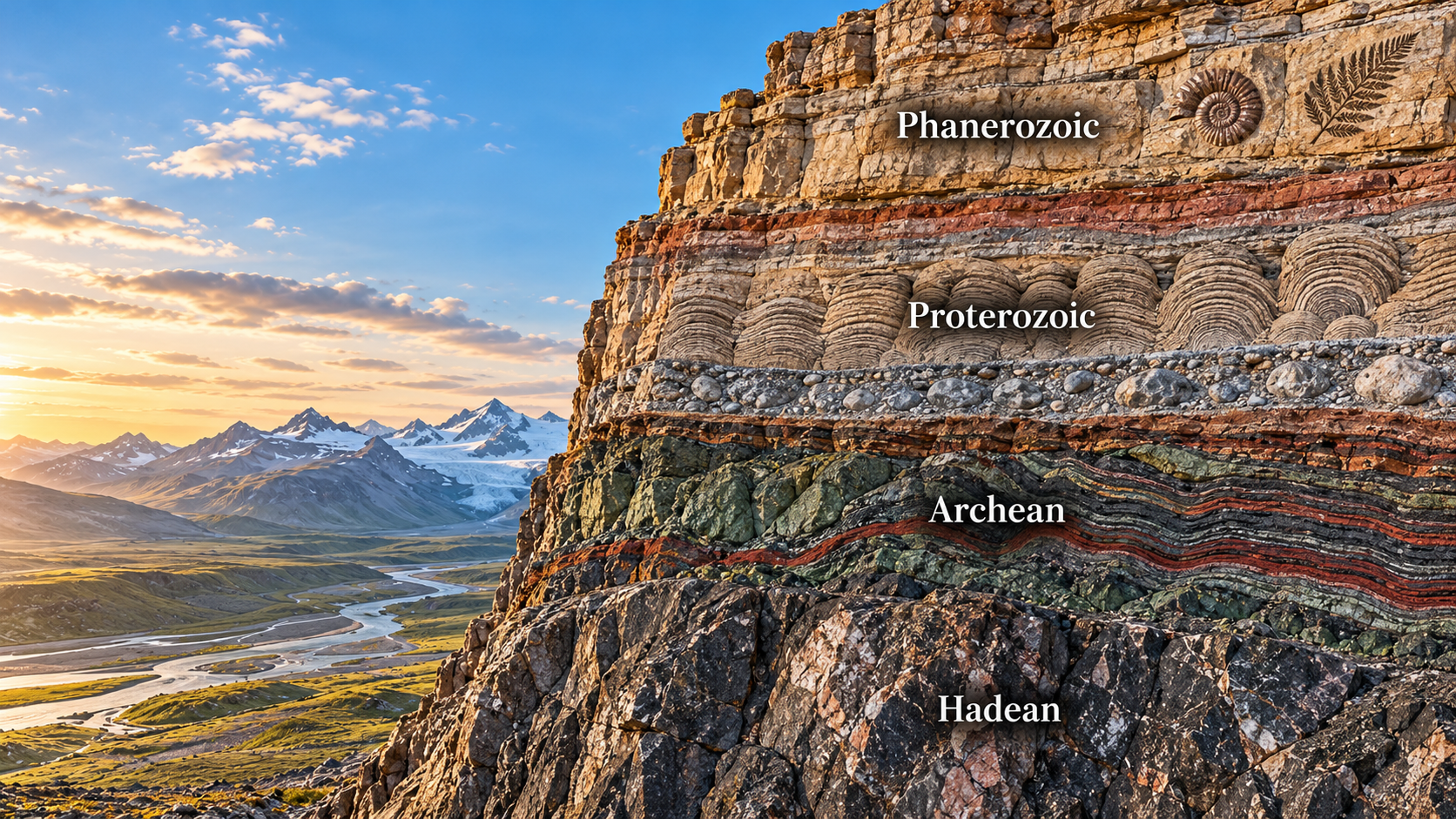
Geological time is the scientific system used to classify Earth’s 4.54-billion-year history. It is not simply a list of time periods: it integrates rock sequences, fossil change, radiometric dating, climatic transitions, mass extinctions, and tectonic events into a single global temporal framework.
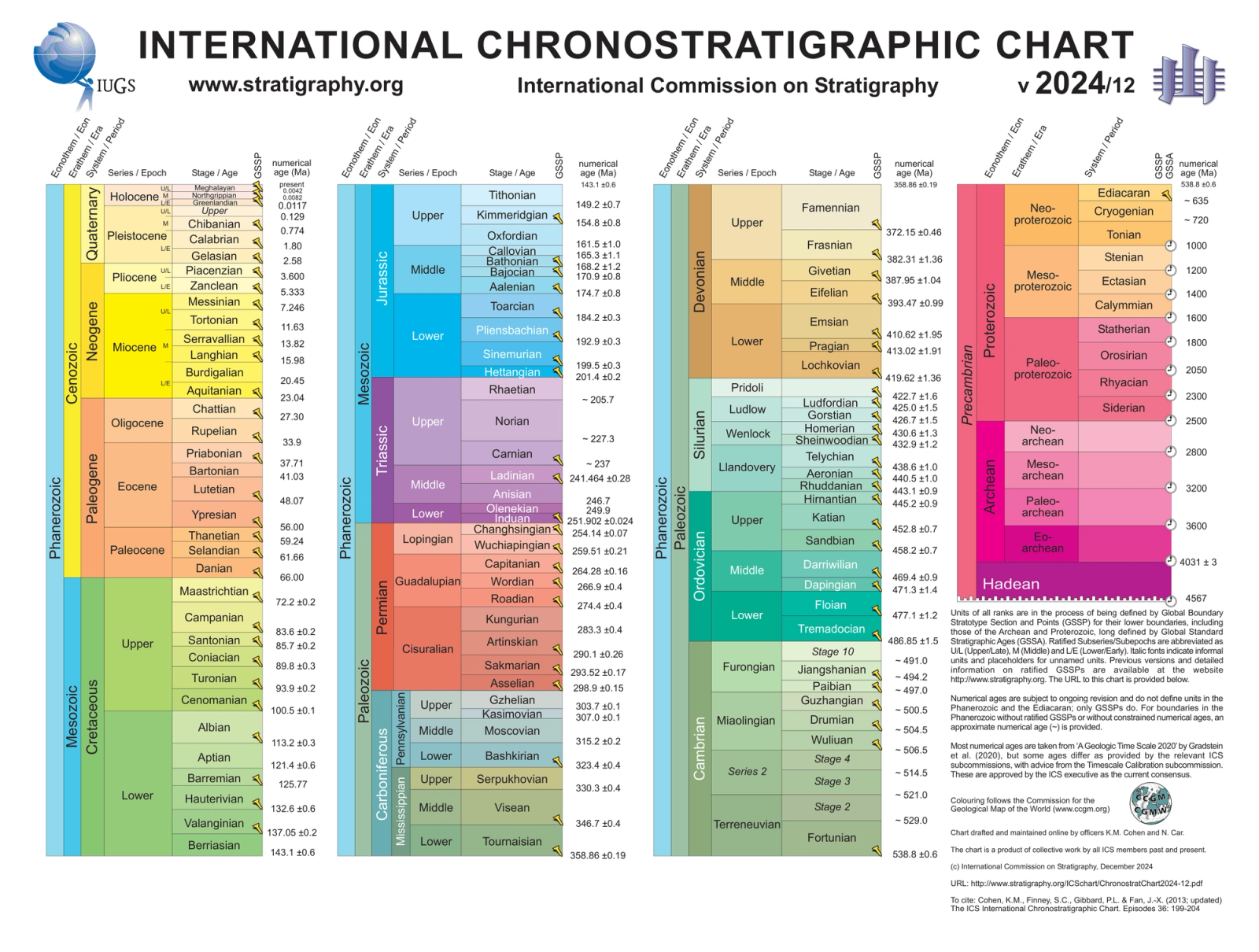
This system allows geologists to answer three fundamental questions: which event occurred first, what is its numerical age, and whether the same event is recorded in rocks from different parts of the world. [1–3]
This article focuses on the structure of the geological time scale, the methods used to measure it, and the principal milestones in Earth’s history.
What Is the Geological Time Scale?
The geological time scale consists of hierarchical units.
An eon is the largest unit of geological time.
An era is a subdivision of an eon.
A period is a subdivision of an era.
An epoch is a shorter subdivision of a period.
An age is one of the smallest commonly used units.
For example, we currently live in the Phanerozoic Eon, the Cenozoic Era, the Quaternary Period, and the Holocene Epoch.
Scientific literature distinguishes between geochronology and chronostratigraphy. Geochronology refers to time units, such as the Jurassic Period. Chronostratigraphy refers to the bodies of rock formed during that time, such as the Jurassic System. The first is a unit of time; the second is its geological record. [1], [3]
Ages are often expressed using the abbreviation Ma, meaning million years ago. For example, 66 Ma means 66 million years ago.
How Are Geological Time Boundaries Defined?
The boundaries of the geological time scale are not chosen arbitrarily. They are established using measurable and reproducible geological evidence.
Many boundaries within the Phanerozoic Eon are defined by GSSPs—Global Boundary Stratotype Sections and Points. A GSSP is a precisely selected layer in a real geological section that officially defines the lower boundary of a time unit. It is sometimes called a “golden spike,” but it is scientifically defined through fossils, chemical changes, magnetic signals, volcanic ash beds, or other correlatable features. [2]
For much older intervals, the preserved rock record is limited or heavily reworked. In these cases, GSSAs—Global Standard Stratigraphic Ages—are used. These are numerical boundaries established through radiometric dating and are especially important for Precambrian time.
The geological time scale is not static. New evidence can refine the numerical age of a boundary, modify subdivisions, or improve correlations between rock records on different continents. This does not mean that Earth’s history changes; it means that the precision of its measurement improves. [1], [3]
How Are Rocks Dated?
Geological chronology is based on two complementary approaches.
Relative dating determines the sequence of events. In an undisturbed sedimentary sequence, lower layers are generally older than the layers above them. Changes in fossil assemblages also allow geologists to compare rocks from distant regions.
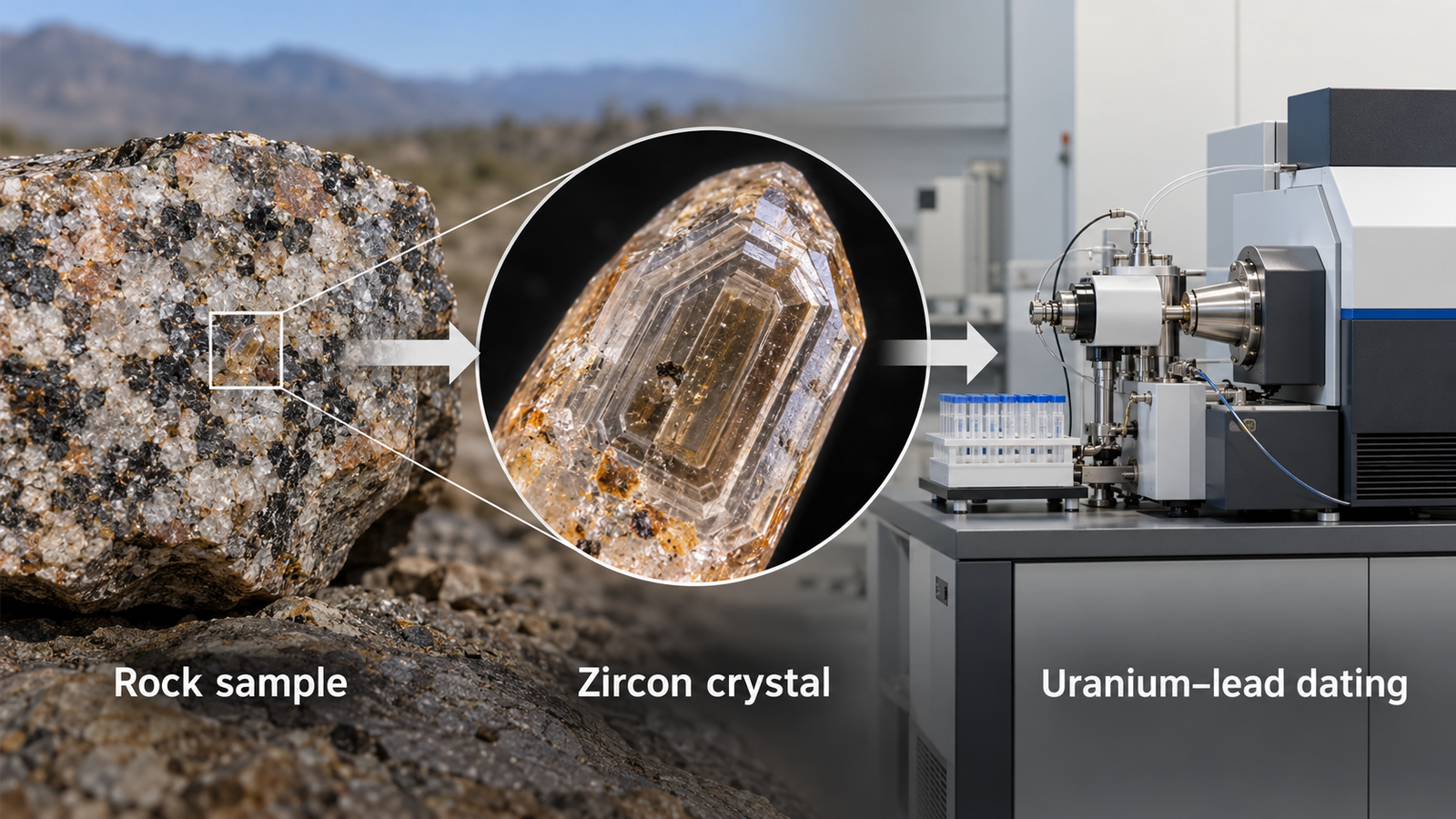
Absolute, or numerical, dating determines an age in years. Its principal tool is radiometric dating, which measures the decay of radioactive isotopes. Uranium–lead dating, especially of zircon minerals, is essential for dating the oldest rocks. Argon–argon dating is widely used for volcanic rocks and ash layers.
These methods work together. Fossils may establish a rock’s relative position in time, while a dated volcanic ash bed can provide its numerical age.
The Hadean Eon: Earth’s Formation
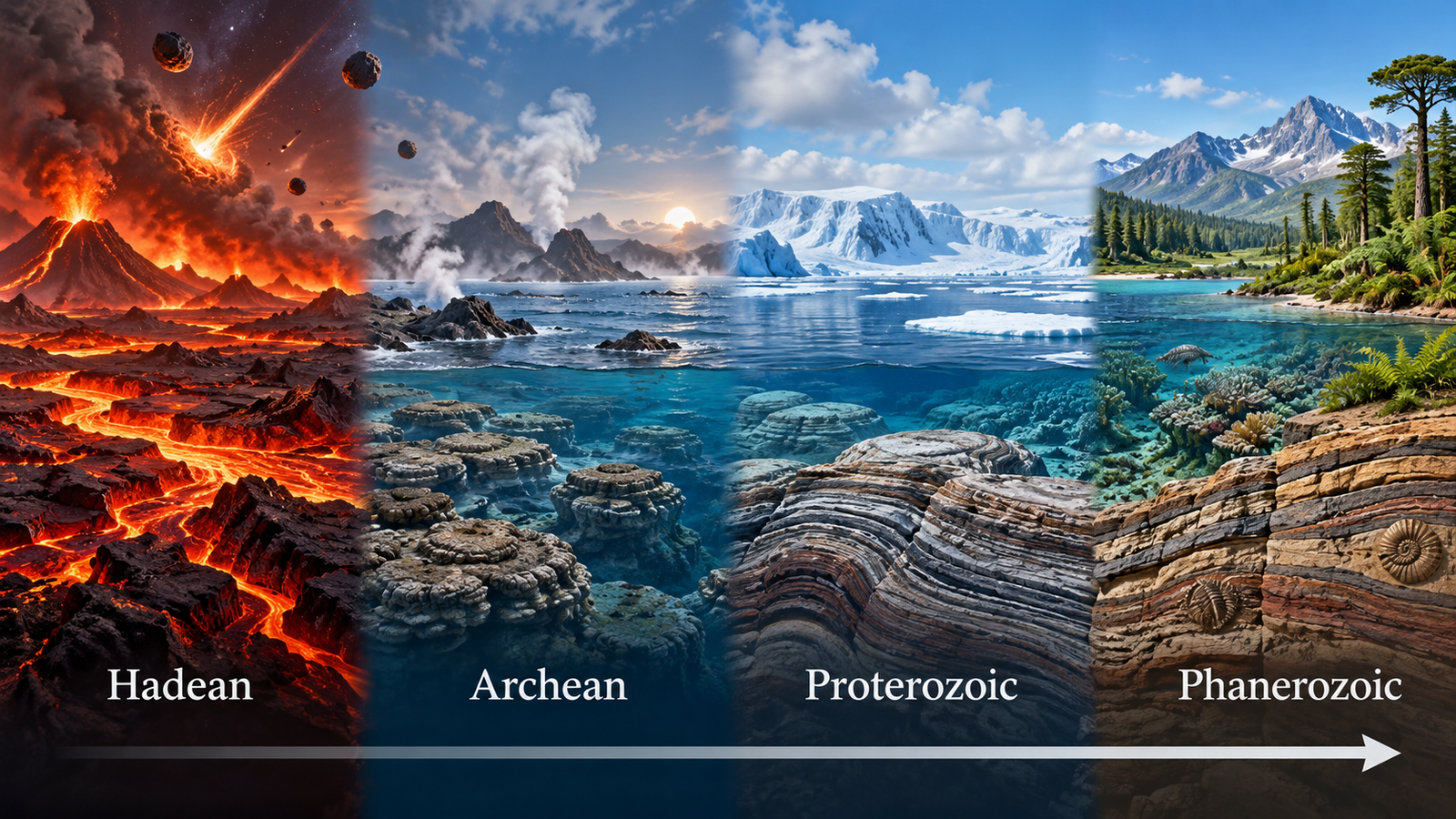
The Hadean Eon begins with the formation of Earth about 4.54 billion years ago. Almost no complete crustal sequences from this time have survived because the early Earth experienced intense magmatism, meteorite impacts, active mantle circulation, and extensive crustal recycling.
Most evidence for the Hadean comes not from preserved mountain belts, but from exceptionally durable minerals, especially zircons. These minerals can preserve information about the temperature, chemical environment, and age of their formation.
During this eon, Earth’s early crust formed, the mantle and core became differentiated, and the foundations of the early atmosphere and hydrosphere developed. The Hadean is important not because of a rich fossil record, but because it established the initial conditions for Earth’s later geological system. [3]
Chronologically, the Hadean extends from approximately 4.54 billion to 4.0 billion years ago. It has no widely used formal division into periods.
The Archean Eon: Early Crust and the First Evidence of Life
The Archean Eon began about 4 billion years ago and ended about 2.5 billion years ago. During this time, many of the oldest preserved continental cores, known as cratons, formed.
Archean rocks contain evidence of early oceans, volcanism, hydrothermal systems, and microbial life. Life was mainly microscopic, and free oxygen in the atmosphere was extremely limited.
Archean geology is also important for the study of plate tectonics. Scientists continue to debate whether a modern-style global plate-tectonic system was already operating or whether warmer mantle conditions favoured vertical and episodic deformation regimes.
The Archean is divided into:
- Eoarchean: approximately 4.0–3.6 billion years ago
- Paleoarchean: 3.6–3.2 billion years ago
- Mesoarchean: 3.2–2.8 billion years ago
- Neoarchean: 2.8–2.5 billion years ago
The Proterozoic Eon: Oxygenation and the Foundations of Complex Life
The Proterozoic Eon lasted from about 2.5 billion to 538.8 million years ago. It was a period of major transformation in Earth’s atmosphere, oceans, and biosphere.
At the beginning of this eon, the Great Oxidation Event occurred. Photosynthetic microorganisms caused free oxygen to accumulate in the atmosphere and oceans. This transformation altered Earth’s chemical environment, influenced mineral formation, and created an essential condition for the later development of complex life. [4]
During the later Proterozoic, multicellular organisms became more widespread. Major glaciations also occurred, some of which may have reached near-global scale. These events are often discussed within the framework of the Snowball Earth hypothesis. [5]

The Proterozoic also includes major continental reorganizations and phases of supercontinent assembly and breakup. This tectonic history was important for the evolution of Earth’s crust and oceans.
The Proterozoic is divided into three eras.
The Paleoproterozoic Era
The Paleoproterozoic lasted from 2.5 to 1.6 billion years ago and includes:
- Siderian
- Rhyacian
- Orosirian
- Statherian
The Mesoproterozoic Era
The Mesoproterozoic lasted from 1.6 to 1.0 billion years ago and includes:
- Calymmian
- Ectasian
- Stenian
The Neoproterozoic Era
The Neoproterozoic lasted from 1.0 billion to 538.8 million years ago and includes:
- Tonian
- Cryogenian
- Ediacaran
The Phanerozoic Eon: A Rich Fossil Record
The Phanerozoic Eon began about 538.8 million years ago and continues today. Its name means “visible life,” because the fossil record becomes much richer during this eon.
The Phanerozoic is divided into the Paleozoic, Mesozoic, and Cenozoic eras.
The Paleozoic Era: From Marine Diversification to Pangaea
The Paleozoic begins with the Cambrian Period, during which animal diversity increased rapidly. This interval is often called the Cambrian diversification. Many animal groups spread during this time, and their hard skeletal parts were well preserved in the fossil record.
During the Ordovician, Silurian, and Devonian, marine life continued to diversify, while plants and animals gradually expanded onto land. During the Carboniferous, extensive swamp forests contributed to the formation of many coal deposits.
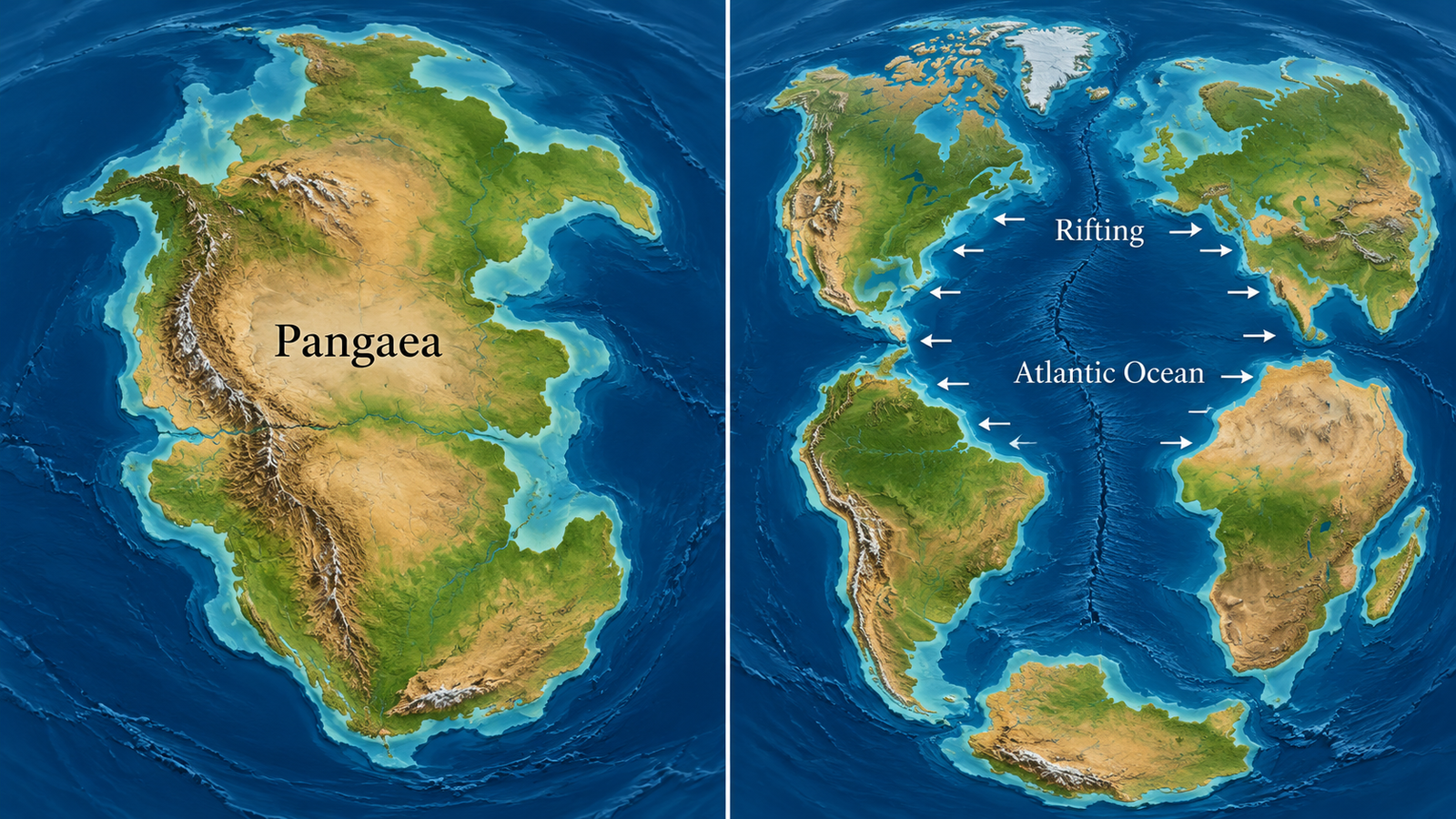
During the late Paleozoic, continental masses assembled into the supercontinent Pangaea. [8]
The Paleozoic ended with the end-Permian mass extinction, the largest mass extinction in Earth’s biological history. This event transformed both marine and terrestrial ecosystems. [6]
The Paleozoic includes:
- Cambrian: 538.8–486.9 million years ago
- Ordovician: 486.9–443.8 million years ago
- Silurian: 443.8–419.2 million years ago
- Devonian: 419.2–358.9 million years ago
- Carboniferous: 358.9–298.9 million years ago
- Permian: 298.9–251.9 million years ago
The Mesozoic Era: The Breakup of Pangaea and New Oceans
The Mesozoic includes the Triassic, Jurassic, and Cretaceous periods. It began after the end-Permian mass extinction, when the biosphere was reorganizing under new environmental conditions.
During the Triassic and Jurassic, Pangaea began to fragment. This process was associated with the formation of rift zones, new oceanic crust, and the later opening of the Atlantic Ocean. During the Mesozoic, dinosaurs became the dominant group of terrestrial vertebrates, while flowering plants spread widely during the Late Cretaceous.
The era ended about 66 million years ago at the Cretaceous–Paleogene boundary. The asteroid impact associated with the Chicxulub impact structure was one of the principal causal factors in this mass extinction. [7]
The Mesozoic includes:
- Triassic: 251.9–201.4 million years ago
- Jurassic: 201.4–143.1 million years ago
- Cretaceous: 143.1–66.0 million years ago
The Cenozoic Era: The Path to the Modern World
The Cenozoic began 66 million years ago and continues today. It includes the Paleogene, Neogene, and Quaternary periods.
During the Cenozoic, mammals, birds, and ecosystems associated with flowering plants diversified widely. Continental movement, mountain building, and the reorganization of ocean circulation also continued.
Over the long term, Earth’s climate cooled. Major ice sheets formed in Antarctica and the Northern Hemisphere, while repeated glacial and interglacial cycles began during the Quaternary. Human history occupies only the most recent and exceptionally short part of this time scale. [9]
The Cenozoic includes:
The Paleogene Period
66.0–23.0 million years ago.
- Paleocene
- Eocene
- Oligocene
The Neogene Period
23.0–2.58 million years ago.
- Miocene
- Pliocene
The Quaternary Period
From 2.58 million years ago to the present.
- Pleistocene: from 2.58 million years ago to about 11,700 years ago
- Holocene: from about 11,700 years ago to the present
Mass Extinctions as Major Boundaries in the Time Scale
Some boundaries in the geological time scale coincide with abrupt changes in the biosphere. The best-known examples include the end-Ordovician, Late Devonian, end-Permian, end-Triassic, and end-Cretaceous mass extinctions.
These events are important not only in biological history. They are often associated with volcanism, climatic change, ocean deoxygenation, sea-level fluctuations, or asteroid impacts. They help scientists correlate rock layers between different continents and reconstruct the rate of biological change.
Conclusion
The geological time scale is not a simplified calendar of Earth’s past. It is an integrated scientific system based on rocks, fossils, chemical signals, magnetic records, and numerical age measurements.
It shows how planetary formation, crustal stabilization, atmospheric oxygenation, biological evolution, plate motion, supercontinent assembly and breakup, glaciations, and mass extinctions are connected within Earth’s 4.54-billion-year history.
Scientific Sources and Books
[1] International Commission on Stratigraphy. International Chronostratigraphic Chart
[2] International Commission on Stratigraphy. Global Boundary Stratotype Sections and Points
[3] Gradstein, F. M., Ogg, J. G., Schmitz, M. D., & Ogg, G. M., eds. Geologic Time Scale 2020. Book
[4] Lyons, T. W., Reinhard, C. T., & Planavsky, N. J. “The Rise of Oxygen in Earth’s Early Ocean and Atmosphere” (2014). Nature. Scientific article
[5] Hoffman, P. F., & Schrag, D. P. “The Snowball Earth Hypothesis: Testing the Limits of Global Change” (2002). Terra Nova. Scientific article
[6] Burgess, S. D., Bowring, S., & Shen, S.-z. “High-Precision Timeline for Earth’s Most Severe Extinction” (2014). Proceedings of the National Academy of Sciences. Scientific article
[7] Schulte, P. et al. “The Chicxulub Asteroid Impact and Mass Extinction at the Cretaceous–Paleogene Boundary” (2010). Science. Scientific article
[8] Seton, M. et al. “Global Continental and Ocean Basin Reconstructions Since 200 Ma” (2012). Earth-Science Reviews. Scientific article
[9] Ehlers, J., & Gibbard, P. L. “The Extent and Chronology of Cenozoic Global Glaciation” (2007). Quaternary International. Scientific article