
Plate Tectonics: Evidence, Driving Mechanisms, and Open Scientific Questions
Plate tectonics explains how moving lithospheric plates shape Earth’s oceans, mountains, volcanoes, and earthquake zones.
Share this story
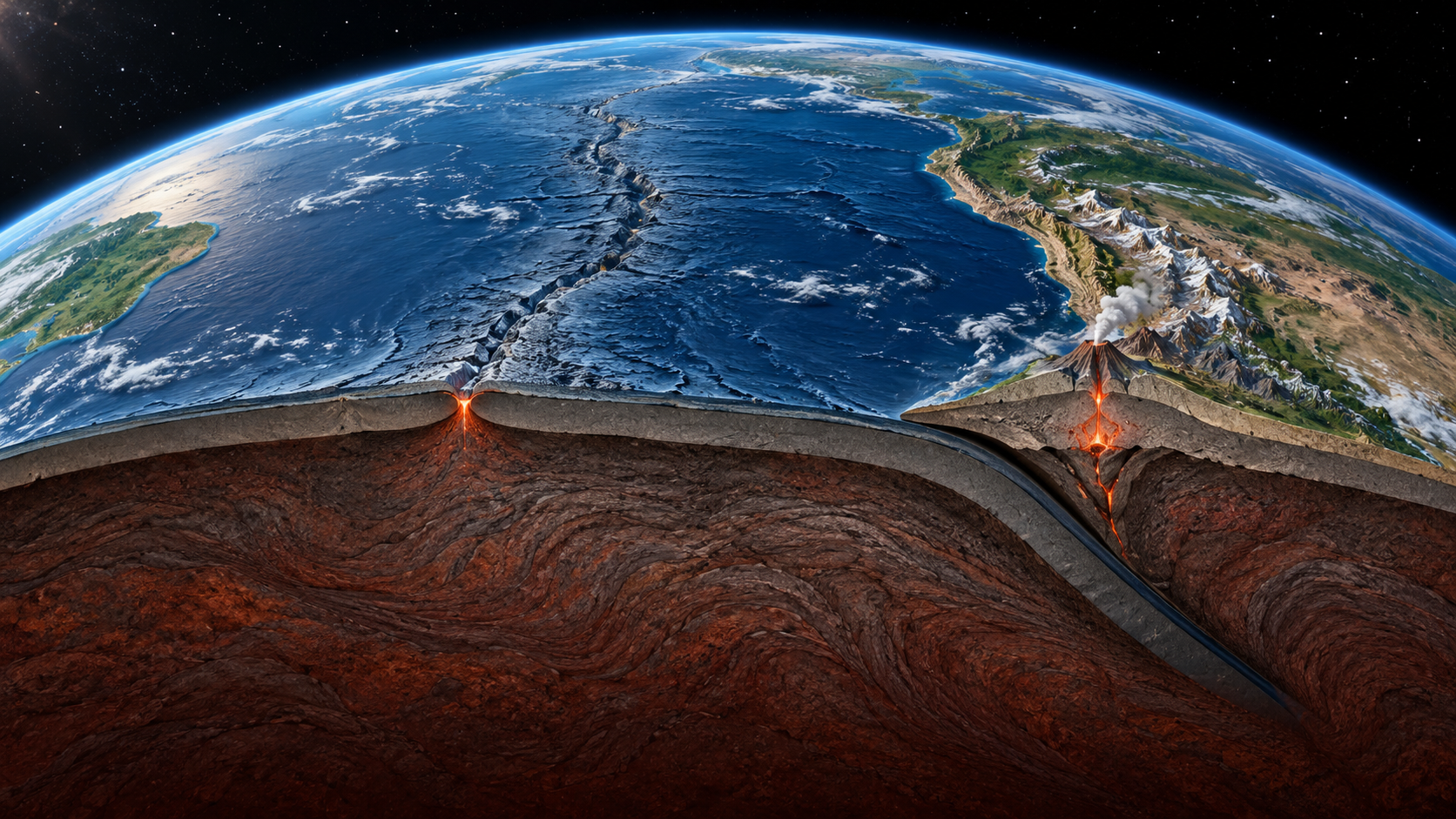
Plate tectonics is the fundamental scientific theory that explains Earth’s internal dynamics. It describes how the lithosphere is divided into moving tectonic plates, how those plates diverge, converge, or move laterally past one another, and how these motions produce oceans, mountain belts, volcanic regions, faults, and earthquake zones.
In science, the word “theory” does not mean an unsupported assumption. A scientific theory is an explanatory framework tested against multiple independent lines of evidence. In the case of plate tectonics, this evidence includes the structure of the ocean floor, the paleomagnetic properties of rocks, the depth distribution of earthquakes, the geographical pattern of volcanoes, satellite geodesy, and direct measurements of crustal motion. [1], [3–7]
In this article, “hypotheses” refers to the principal historical theories and active scientific models documented in geological literature. These should be distinguished from claims that are not testable or are unsupported by evidence.
Lithosphere, Asthenosphere, and Tectonic Plates
The lithosphere is Earth’s upper mechanical layer. It includes the crust and the part of the upper mantle that is relatively cool and strong enough to deform as a rigid body.
Below the lithosphere lies the asthenosphere, a hotter and mechanically weaker part of the upper mantle. The asthenosphere is not an ocean of liquid magma. It consists mainly of solid rock that can deform and flow extremely slowly under high temperatures over geological time.
A tectonic plate is a relatively rigid segment of the lithosphere that moves in relation to adjacent plates. Plates are not perfectly rigid: faults, volcanoes, and slowly deforming regions can occur within them. However, over millions of years, they can often be treated as relatively coherent moving units. [1], [7], [10]
The Three Main Types of Plate Boundaries
The relationship between tectonic plates is defined not by the shape of continents or oceans, but by their relative motion.
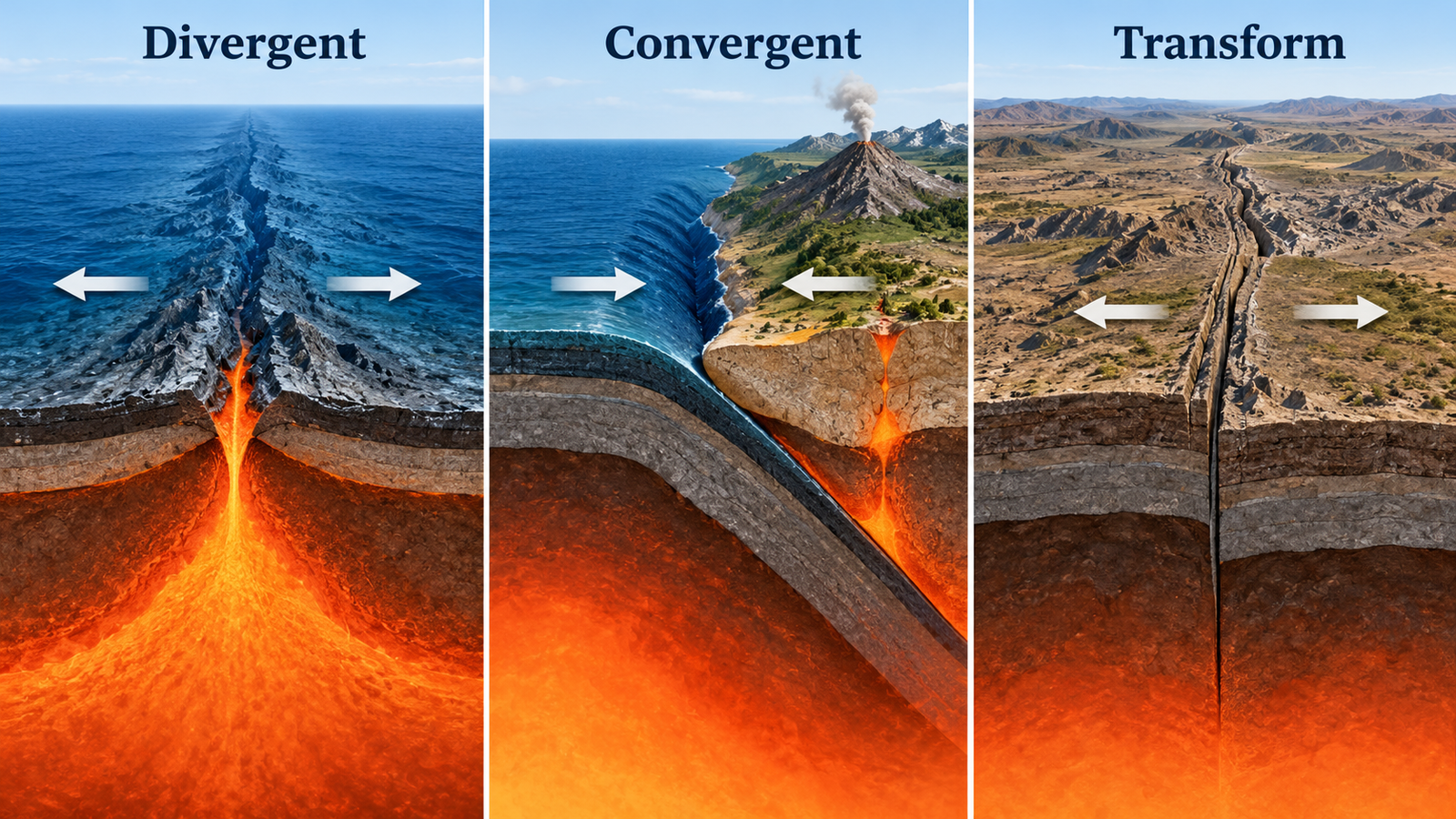
At divergent boundaries, plates move away from one another. At mid-ocean ridges, this separation allows mantle material to rise, partially melt, and form new oceanic crust. On continents, the same process can create rift zones, normal faults, and sedimentary basins.
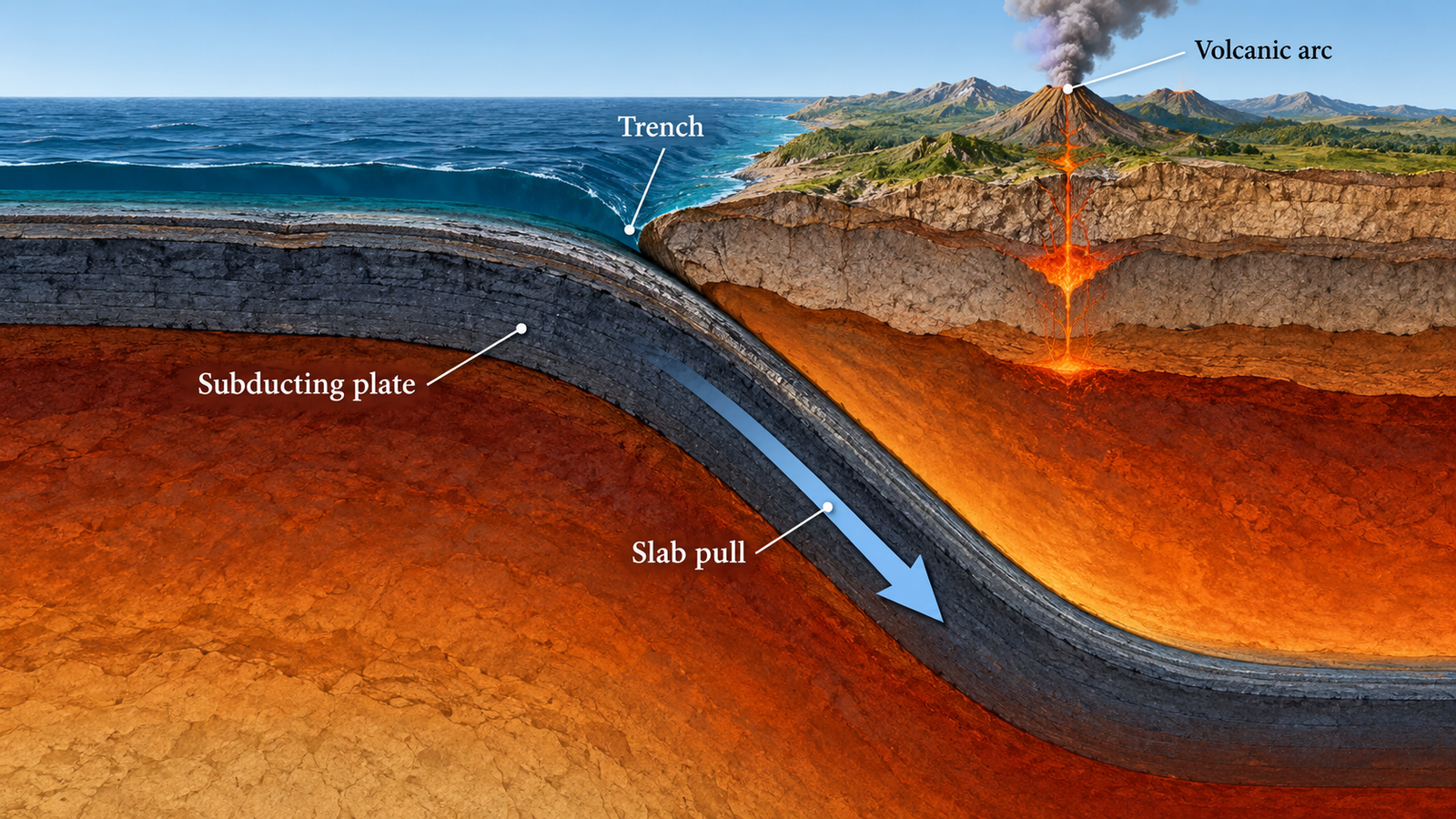
At convergent boundaries, plates move toward one another. If an oceanic plate meets another plate, it may descend beneath it. This process is called subduction. Subduction produces deep-sea trenches, powerful earthquakes, volcanic arcs, and mountain-building zones. When two continental plates collide, their relatively low density makes deep subduction difficult, so the crust is mainly shortened, thickened, and uplifted into major mountain belts.
At transform boundaries, plates move laterally past one another. These boundaries do not usually produce broad oceans or major volcanic arcs, but they can generate powerful earthquakes. If a fault bends, or if plate motion is oblique rather than fully parallel to the fault, local compression can create uplifts, folds, and fault-related mountains. [1], [5], [10]
Evidence for Plate Tectonics
Plate tectonics was accepted not because of one observation, but because of multiple independent and mutually consistent lines of evidence.
The first important group of observations is the geological correspondence between continents. Rock belts, ancient mountain systems, fossil organisms, and paleoclimatic evidence often continue across the opposing margins of South America and Africa. These observations helped Alfred Wegener develop the idea of continental drift. [2]
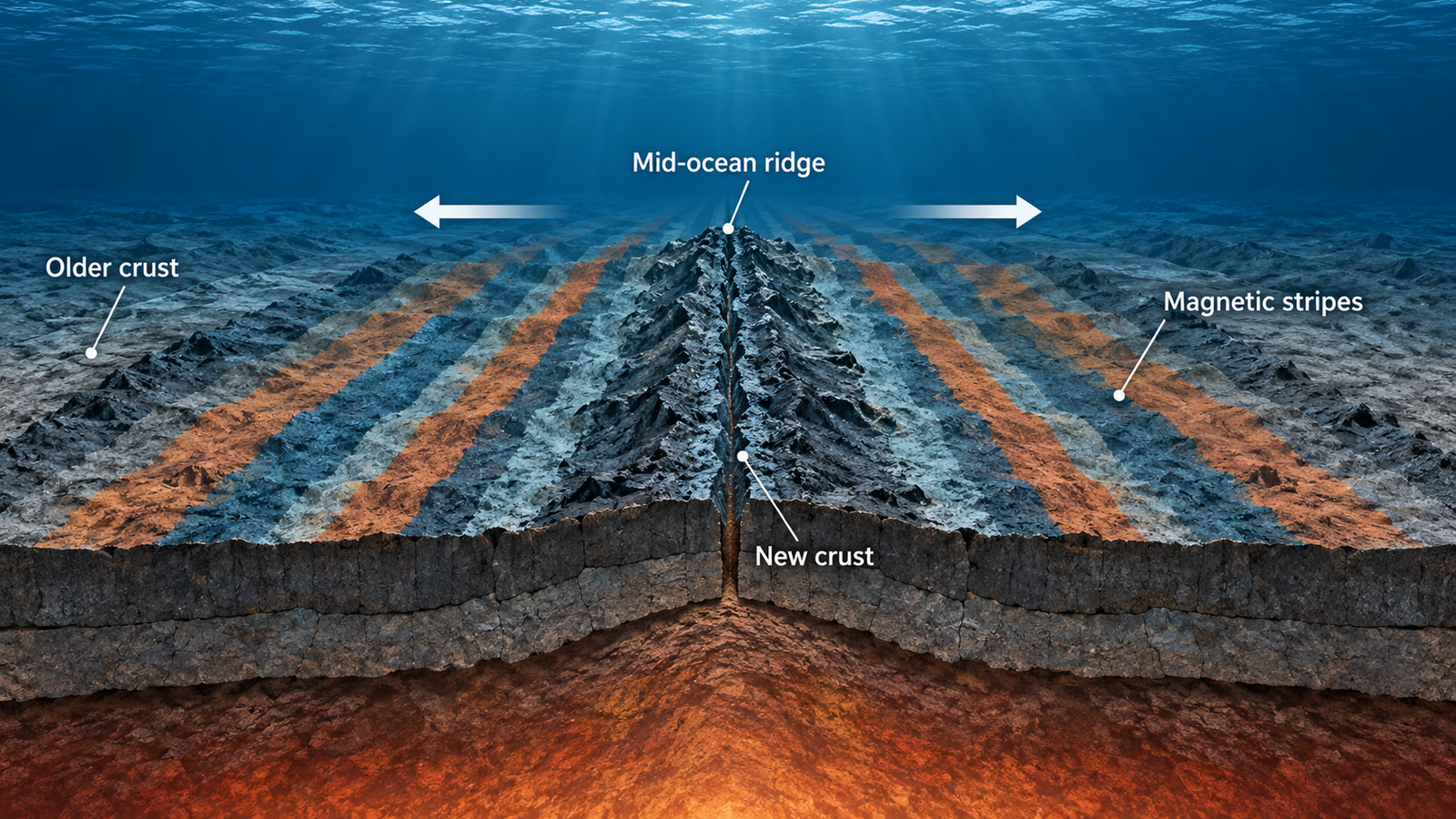
A second decisive line of evidence came from research on the ocean floor. Moving away from mid-ocean ridges, the age of ocean-floor rocks increases and sediment cover becomes thicker. This pattern is consistent with the formation of new oceanic crust at ridges and its gradual movement away from them. [1], [3]
A third line of evidence comes from paleomagnetism. When basaltic magma cools, magnetic minerals preserve the direction of Earth’s magnetic field at that time. Magnetic stripes on the ocean floor occur in symmetrical patterns on opposite sides of mid-ocean ridges. They record repeated reversals of Earth’s magnetic polarity while also demonstrating seafloor spreading. [4]
A fourth line of evidence is seismicity. In subduction zones, earthquake hypocentres form inclined belts that extend deep into Earth. These are known as Wadati–Benioff zones, and they trace the path of a tectonic plate descending into the mantle. Seismic tomography can also image cold, dense remnants of subducted plates at great depth. [1], [10]
Finally, modern geodetic measurements show that relative plate motion continues today. Satellite observations, GPS stations, marine magnetic data, and earthquake-mechanism studies make it possible to measure the direction and rate of plate motion. [7]
From Continental Drift to Modern Plate Tectonics
In 1912, Alfred Wegener introduced the idea of continental drift, which he developed further in his 1915 book. He argued that continents had once been joined and later moved apart. His evidence included the approximate fit of continental margins, the distribution of fossils, the continuity of rock belts, and evidence of ancient glaciation. [2]
Wegener’s central conclusion—that continents move—was correct. However, his proposed mechanisms were inadequate. He could not explain what force moved continents, and the structure of the ocean floor was still largely unknown.
Later, Arthur Holmes proposed that thermal convection in the mantle might contribute to continental motion. This was an important idea, but mantle convection alone did not explain how oceanic crust forms and is destroyed.
During the 1960s, Harry Hess’s concept of seafloor spreading filled this gap. In this model, new oceanic crust forms at mid-ocean ridges, moves away from them, and is eventually recycled into the mantle at subduction zones. [3]
The paleomagnetic explanation developed by Vine and Matthews showed that the symmetrical magnetic stripes of the ocean floor were a direct record of this spreading process. [4] John Tuzo Wilson clarified the role of transform faults, while mathematical and kinematic models developed in the late 1960s integrated plate movements into a global system. [5], [6]
Plate tectonics is therefore not simply the idea that continents move. It explains the formation, transport, deformation, and recycling of the lithosphere on a planetary scale.
What Drives Tectonic Plates?
Science does not recognize one universal force that moves every tectonic plate in the same way. Plate motion results from a balanc
e of forces, and their relative importance varies from one plate to another.
One of the most important factors is slab pull. As oceanic lithosphere cools, it becomes denser. When it enters a subduction zone, its greater density helps it descend into the mantle. If the descending part remains mechanically attached to the rest of the plate, it can pull the entire plate toward the subduction zone. [8], [9]
A second factor is often described as ridge push, more accurately understood as gravitational sliding away from a mid-ocean ridge. This is not a literal pushing force exerted by the ridge. Oceanic lithosphere near a ridge is hot, thin, and elevated; as it moves away, it cools, thickens, and subsides. The resulting gravitational potential difference contributes to plate motion away from the ridge.
Other important factors include pressure differences within the mantle, shear traction between the base of the plate and the mantle, resistance at subduction zones, friction along faults, and the force required to bend a plate as it descends. Mantle convection and plate motion are not separate processes in which one simply drives the other. They form a coupled system: plates influence mantle flow, and mantle flow influences plate motion. [8–10]
Plate Creation, Destruction, and the Wilson Cycle
Oceanic lithosphere does not accumulate indefinitely. It is created at divergent boundaries and is mainly recycled at subduction zones. This balance is one reason why the ocean floor is geologically young compared with continental crust.
Ocean basins can open, widen, begin to close, and eventually disappear through continental collision. This sequence is known as the Wilson cycle. It is a useful geological model, but not a strict law; every ocean basin has its own tectonic history, boundary conditions, and rates of movement.
The breakup of Pangaea and the opening of the Atlantic Ocean provide a clear example of this process. The opposite process is represented by the closure of former ocean basins, subduction, and the formation of collision-related mountain belts.
Historically Rejected or Replaced Theories
Before plate tectonics emerged, several models attempted to explain mountain belts and continental structure.
Fixism assumed that continents and oceans were largely permanent in their positions. This approach is inconsistent with paleomagnetic continental movement, symmetrical magnetic stripes on the ocean floor, and directly measured plate motions. [4], [7]
The contracting Earth hypothesis explained mountain belts as wrinkles formed as the planet cooled and contracted. Thermal contraction can influence certain local processes, but it cannot explain the generation of new oceanic crust, subduction, deep-sea trenches, or the systematic relative motion of tectonic plates.
Geosynclinal theory described the accumulation of sediment in large basins followed by later mountain building. It provided a useful descriptive framework before plate tectonics, but it did not offer a global mechanism capable of explaining the opening and closure of oceans or plate motion.
The expanding Earth hypothesis argued that continents moved apart because Earth’s radius increased. This model is not accepted in modern geoscience because it cannot explain the seismic structure of subduction zones, the age distribution of oceanic crust, or the consistent evidence for lithospheric recycling. [1], [3], [4], [7]
Current Scientific Debates
The factual foundation of plate tectonics is well established, but important questions remain open.
When Did Plate Tectonics Begin?
Scientists do not yet agree on when the modern, global, self-sustaining plate-tectonic system began operating on Earth.
Some researchers interpret ancient Archean rocks as evidence of early subduction, continental collision, and plate motion. Others argue that the hotter mantle of the early Earth may have made modern-style subduction difficult because young oceanic lithosphere would have been warmer and more buoyant. They propose that early Earth may have operated in an episodic mobile-lid, stagnant-lid, or predominantly vertical-deformation regime. [11], [12]
A central issue is the definition of plate tectonics itself. Evidence for local subduction does not necessarily demonstrate the existence of a global network of tectonic plates like the one observed today. Much of Earth’s earliest geological record has been recycled or destroyed, leaving an incomplete archive.
Alternative Models for Early Earth Dynamics
In the stagnant-lid model, the lithosphere does not break into independently moving plates. Heat escapes mainly through mantle upwellings and surface volcanism, while the outer shell remains relatively continuous for long periods.
In an episodic mobile-lid regime, subduction and large-scale plate motion may have begun and stopped repeatedly. This model represents an intermediate state between stagnant-lid behaviour and continuous modern plate tectonics.
In models of vertical tectonics or sagduction, rock masses of different densities move mainly upward and downward. Dense greenstone belts, for example, may sink into lighter granitic crust while granitic material rises. These models are especially relevant to the evolution of Archean crust and are not intended as replacements for modern global plate tectonics.
In the heat-pipe model, the high heat flow of the early Earth may have been removed largely through intense volcanism and the burial of volcanic crust, rather than through long-lived modern-style subduction zones. [11], [12]
How Does Subduction Begin?
Once a mature subduction zone is established, the negative buoyancy of a descending oceanic plate can help sustain its downward motion. The initial stage—subduction initiation—is more difficult to explain.
Proposed mechanisms include the gravitational instability of old, dense oceanic lithosphere; reactivation of pre-existing faults; local compression near transform boundaries; collision between plates; and the influence of mantle flow. Numerical models indicate that subduction initiation often requires a pre-existing weak zone or an external tectonic force. [13]
Whole-Mantle or Layered Convection?
The structure of mantle convection remains another long-standing area of research. The whole-mantle convection model proposes that material can circulate between the upper and lower mantle. In layered convection models, certain deep boundaries limit this exchange.
Seismic tomography indicates that some subducted slabs can pass through transition zones between the upper and lower mantle. However, this does not mean that the mantle mixes uniformly. Temperature, composition, viscosity, and mineral phase transitions continue to complicate the picture. [10]
Mantle Plumes or Lithosphere-Controlled Volcanism?
Intraplate volcanic chains such as the Hawaiian Islands are often explained by the mantle-plume model. In this model, a relatively narrow upwelling of hot material rises from deep within the mantle, producing magma as a tectonic plate moves above it. [14]
However, not all intraplate volcanoes are explained in the same way. In some regions, researchers consider the role of lithospheric fractures, mantle flow near plate edges, remnants of earlier subduction, or local extension. This debate is not an argument against plate tectonics; it concerns the conditions and depths at which intraplate magma is generated.
How Scientists Reconstruct Plate Histories
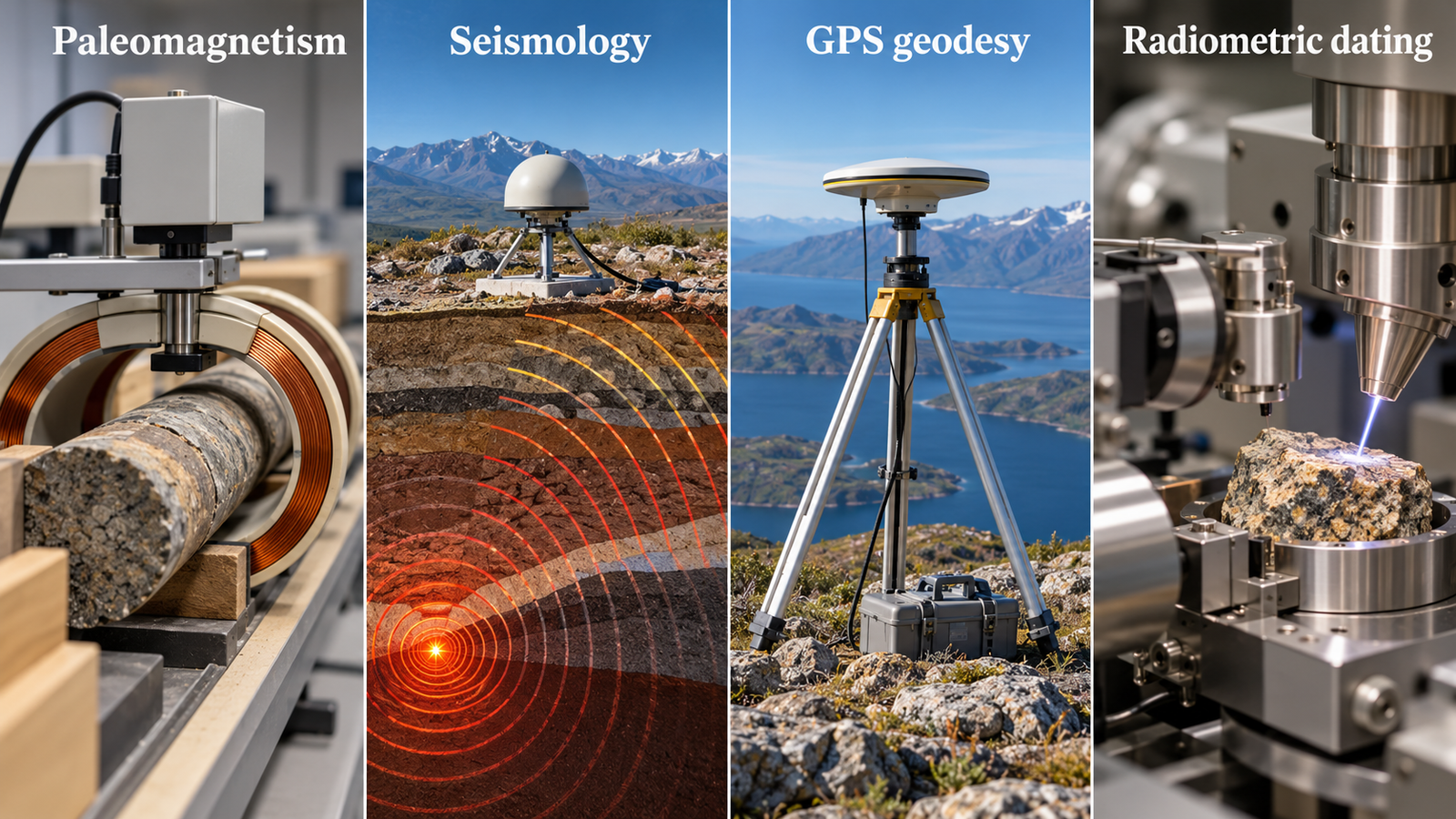
The history of tectonic plates is reconstructed by combining independent methods.
- Paleomagnetism helps determine the ancient latitude of rocks and the relative rotation of crustal blocks.
- Radiometric dating establishes the ages of rocks, volcanic layers, and metamorphic events.
- Marine geophysics maps mid-ocean ridges, deep-sea trenches, magnetic stripes, and the age of oceanic crust.
- Seismology determines earthquake locations and the direction of movement along faults.
- Seismic tomography images thermal and density variations within the mantle.
- Satellite geodesy and GPS measurements record present-day deformation and relative plate motion.
- Numerical geodynamic models test whether proposed forces and material properties can produce observed geological structures. [7], [10]
Conclusion
Plate tectonics is the best-supported global explanation for the movement and recycling of Earth’s lithosphere. It is based on multiple independent lines of evidence: seafloor spreading, paleomagnetic stripes, subduction-zone seismicity, volcanic arcs, geological reconstructions, and modern geodetic measurements.
The remaining questions do not concern whether tectonic plates exist and move today. Instead, they focus on how subduction began, when a global plate-tectonic regime emerged, how strongly the mantle is layered, and how different driving forces control different plates. These questions do not weaken plate tectonics; they define the research frontiers through which the theory continues to develop.
Scientific Sources and Books
[1] U.S. Geological Survey. This Dynamic Earth: The Story of Plate Tectonics
[2] Wegener, A. The Origin of Continents and Oceans (1915). Digitized book
[3] Hess, H. H. “History of Ocean Basins” (1962). Scientific chapter
[4] Vine, F. J., & Matthews, D. H. “Magnetic Anomalies Over Oceanic Ridges” (1963). Nature. Scientific article
[5] Wilson, J. T. “A New Class of Faults and Their Bearing on Continental Drift” (1965). Nature. Scientific article
[6] McKenzie, D. P., & Parker, R. L. “The North Pacific: An Example of Tectonics on a Sphere” (1967). Nature. Scientific article
[7] DeMets, C., Gordon, R. G., & Argus, D. F. “Geologically Current Plate Motions” (2010). Geophysical Journal International. Scientific article
[8] Forsyth, D., & Uyeda, S. “On the Relative Importance of the Driving Forces of Plate Motion” (1975). Geophysical Journal International. Scientific article
[9] Conrad, C. P., & Lithgow-Bertelloni, C. “How Mantle Slabs Drive Plate Tectonics” (2002). Science. Scientific article
[10] Turcotte, D. L., & Schubert, G. Geodynamics, 3rd ed. (2014). Cambridge University Press. Book
[11] Korenaga, J. “Initiation and Evolution of Plate Tectonics on Earth: Theories and Observations” (2013). Annual Review of Earth and Planetary Sciences. Scientific review
[12] Stern, R. J. “When and How Did Plate Tectonics Begin? Theoretical and Empirical Considerations” (2007). Chinese Science Bulletin. Scientific review
[13] Stern, R. J., & Gerya, T. “Subduction Initiation in Nature and Models: A Review” (2018). Tectonophysics. Scientific review
[14] Morgan, W. J. “Convection Plumes in the Lower Mantle” (1971). Nature. Scientific article